



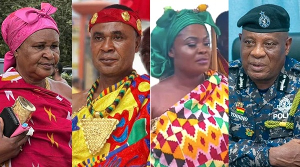
 The killing of late Abambahemaa Nana Serwaa Asamaa Agyakoma linked to chieftaincy and land conflicts
As investigations into the killing of Abambahemaa Nana Serwaa Asamaa Agyakoma at Atebubu in the Bono East Region continue, residents of Amantin, Akokoa and Abamba are increasingly drawing attention to what they describe as the deeper historical tensions that preceded the murder and the subsequent criminal investigations.
According to elders and long-time residents, the current crisis did not emerge overnight, but developed over several years through growing disputes over traditional authority, succession and land administration within the Amantin Traditional Area.
Many residents interviewed said one question continues to dominate discussions across the area: how did a traditional arrangement that had coexisted relatively peacefully for decades become engulfed in disputes over land and authority?
Community members say that until approximately five years ago, major land disputes were largely uncommon within the Amantin Traditional Area.
Historically, both Akokoa and Abamba operated under the broader authority of the Amantin chieftaincy, with chiefs and queen mothers functioning within a largely unified traditional structure.
Residents recall that the Amantin Traditional Council routinely facilitated the allocation and sale of large tracts of land to investors, particularly for agricultural projects, without significant resistance from subordinate communities.
According to community elders, several private investors and commercial farming operators acquired land in the area over the years, including businessman and NPP stalwart Kennedy Agyapong and one Oppong Bio, whose agricultural investments involved cassava cultivation and starch processing.
For many residents, the historical acceptance of such land transactions raises questions about why land ownership has now become a major source of conflict. They trace the origin of the current tensions to the period following the death of Osaberima Owusu Ababio I in 2021.
Community members describe the late chief as a unifying figure who maintained stable relationships among chiefs and queen mothers under the Amantin traditional structure.
Residents say that under his leadership, competing interests were largely managed without major public disputes, helping to preserve cohesion within the traditional area.
According to traditional insiders, divisions began to deepen following his passing. Residents recount that the current Amantin queen mother, Nana Serwaa Bonsu Brakatu II, was destooled in the 1980s by Osaberima Owusu Ababio I for alleged insubordination.
Community elders claim that the decision received the backing of Manhyia during the reign of the late Asantehene, Otumfuo Opoku Ware II.
The destoolment reportedly led to years of litigation and traditional disputes between the queen mother and the late chief.
According to residents, mediation efforts by the current Asantehene, Otumfuo Osei Tutu II, eventually helped resolve the longstanding dispute, resulting in the reinstatement of Nana Serwaa Bonsu Brakatu II.
However, some residents allege that following the death of Osaberima Owusu Ababio I, divisions within the traditional area intensified.
They claim that chiefs and queen mothers perceived as loyal to the late chief increasingly found themselves at the centre of traditional disputes.
Residents further allege that the queen mother supported the installation of her brother, Osabarima Bonsie Apau Bonsu II, known privately as Frederick Osei Bonsu, a Kumasi-based Warrant Officer in the Ghana Armed Forces, as the current Amantin chief.
Community members claim that the current traditional leadership subsequently pursued destoolment proceedings and other disputes involving several chiefs and queen mothers within the Amantin Traditional Area.
According to residents, disagreements that were once isolated gradually evolved into broader divisions affecting the entire traditional structure.
Some residents further allege that narratives presented to Manhyia portrayed certain subordinate chiefs as threats to lands associated with the Asante Kingdom.
Tensions have been heightened in recent weeks following the circulation of social media videos containing comments attributed to Otumfuo Osei Tutu II regarding chiefs allegedly attempting to take over lands linked to the Asante Kingdom.
Despite this, many residents insist that the core disputes are not primarily territorial, but stem from struggles over succession, influence and authority within the traditional area itself.
Several elders maintain that major land disputes involving Amantin and Atebubu were largely settled decades ago, particularly following agreements reached in the late 1970s.
As a result, residents say they are puzzled by the recent resurgence of conflicts over land ownership after years of peaceful coexistence and investment activity.
Community members note that successive traditional administrations previously welcomed private agricultural investment without major controversy.
They argue that the current disputes over lands long occupied or cultivated by investors appear inconsistent with the area’s historical experience.
Residents also spoke about what they describe as longstanding ties between the current Amantin royal household and individuals connected to Manhyia Palace.
According to community members, family relationships linking the Amantin royal household to people close to the Asantehene have contributed to the perception that narratives originating from the current leadership enjoy greater influence at Manhyia.
Some elders further claim that the Asantehene’s late biological father, Ohenenana Kwame Boakye Dankwa, spent considerable time farming in Amantin and maintained family connections, including a son, who is a half-brother to Otumfuo Osei Tutu II, in the area commonly known as “Chief”.
Ohenenana Kwame Boakye Dankwa, who died in 2002, hailed from the village of Kentinkyere in the Atwima District of the Ashanti Region and served as the Brahyia Duke of Asante and Brahyiahene.
Residents say these historical relationships have created concerns among some sections of the community that alternative perspectives are not always adequately represented.
Many residents expressed concern that disputes which began as internal traditional disagreements have now escalated into a major criminal investigation involving murder allegations, arrests, deaths in custody, conspiracy accusations and growing public mistrust.
Some traditional leaders in the area have also sought to exploit the standoff and public spat between Otumfuo Osei Tutu II and the Dormaahene, Agyemang Badu II, by choosing where they feel safer.
For some elders, the situation represents the breakdown of a traditional arrangement that had endured for decades through cooperation and shared authority.
They warn that unless efforts are made to address both the immediate criminal case and the underlying traditional grievances, tensions within the Amantin Traditional Area could deepen further and undermine long-term peace.
As investigations into the killing of the Abamba queen mother on Wednesday, 25 February 2026, continue, residents say that understanding the crisis’s historical origins may prove just as important as resolving the criminal case itself.
For many in the community, the murder investigation is seen not as an isolated event but as the culmination of years of unresolved disputes over authority, succession, influence, repeated assaults, the burning of motorbikes, and the future direction of one of the area’s most interconnected traditional communities.

Copyright © 1994 - 2026 GhanaWeb. All rights reserved.










