



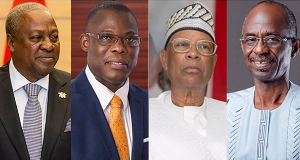
 From Left - President John Mahama, Fifi Kwetey, Alhaji Mahama Iddrisu, Asiedu Nketiah
The Council of Elders of the governing National Democratic Congress (NDC) has issued a stern warning to party members against engaging in premature presidential campaign activities ahead of the next general election, urging them instead to focus on supporting the government’s “Resetting Agenda” and maintaining internal discipline and party unity.
The intervention follows an emergency closed-door consultative meeting between the influential advisory body and President John Dramani Mahama at the Flagstaff House on Friday, May 29, 2026.
Notably, the meeting was held without the participation of the party’s General Secretary, Fifi Kwetey, and National Chairman, Johnson Asiedu Nketiah.
The Herald’s sources familiar with developments within the ruling party revealed that this extraordinary intervention became necessary amid growing concerns over what some insiders describe as a breakdown in internal command and control, fuelled by increasing manoeuvring among individuals with ambitions to succeed President Mahama as the party’s future presidential candidate.
The Council of Elders, chaired by Alhaji Mahama Iddrisu, has reportedly made several attempts in recent months to discourage leading party figures from embarking on what are perceived as early campaign activities camouflaged as “thank-you tours”, health walks and media-sponsored opinion polls aimed at promoting presidential ambitions, to no avail.
The Herald’s information is that one prominent aspirant recently walked out of Cabinet and has since boycotted its meetings, following complaints that his political activities were diverting attention from government business. Other senior figures are also positioning themselves, both openly and discreetly, for the anticipated presidential contest, hence not working.
Previous attempts to curb the disturbing situation, described as very “unhealthy”, led to last month’s epistle by the Executive Secretary to the President, Callistus Mahama, which called for restraint within the ruling NDC and cautioned against premature discussions about succession and leadership contests ahead of the 2028 general elections.
Many observers interpreted the publication as evidence of concerns within the Presidency over increasing factional activity within the governing party. They believe that the Executive Secretary to the President could not have issued that epistle without his boss’ permission, further demonstrating how worried the presidency is about the development.
Strategic discussions at Friday’s meeting centred primarily on reinforcing party unity, enforcing strict internal discipline, and mobilising maximum grassroots support for the government’s flagship “Resetting Agenda”.
The council expressed grave concern over growing operational reports of early, well-funded campaign activities by certain individuals and interest groups within the umbrella fraternity. It warned that such actions are highly likely to undermine party cohesion and dangerously distract the state from its core governance priorities.
The strongly-worded communique released to the press following the high-stakes meeting, the council reminded all ambitious members that the party’s supreme mandate at this historic juncture is to deliver tangible development to the people of Ghana.
The elders called on all ranks to immediately channel their intellectual energies and financial resources into supporting the government’s structural development agenda.
Spelling out its expectations for the rank and file, the Council stated: “At this critical stage of national reconstruction and renewal, every member of the Party is expected to devote his or her energies, resources, and commitment to supporting the Government’s efforts to reset the country and improve the lives of Ghanaians, rather than engaging in activities that have the potential to create division, distraction, or unnecessary internal competition.”
To anchor its directive in party law, the Council of Elders cited Article 42 of the NDC Constitution, which explicitly outlines the formal timelines, legal frameworks, and protocols for the election of a flagbearer.
The elders reminded all potential hopefuls that such sensitive processes are under the strict, exclusive jurisdiction of the National Executive Committee (NEC).
The statement emphasised that until the NEC explicitly rolls out a formal timetable and publishes official guidelines for the presidential primaries, no individual, group, or proxy organisation has the legal or political authorization to engage in any form of campaigning, whether directly or indirectly.
Reaffirming the party’s constitutional supremacy, the communique noted: “The Council emphasises that, until the appropriate constitutional processes have been initiated and the National Executive Committee has determined the timetable and guidelines for the conduct of presidential primaries, no individual, group, or interest bloc is authorized to undertake or promote any form of presidential campaign, whether directly or indirectly.”
Consequently, the Council of Elders has issued a final, binding directive ordering all persons currently involved in backdoor campaigning to cease and desist immediately. This sweeping ban covers all forms of media campaigning, structural mobilisation, public endorsements, and related internal political machinations.
The elders urged the global membership of the NDC to remain unswervingly focused on party unity and state governance, assuring them that internal democratic competitions would be robustly addressed when the constitutional window officially opens.
Concluding its advisory with a call for patience and collective responsibility, the Council added: “The time for internal contests will come. For now, our collective responsibility is to serve the nation and successfully implement the mandate entrusted to us.”
Last month, the Executive Secretary to the President issued a stern caution to Mahama appointees and party figures nursing ambitions to lead the NDC, urging them to step aside if their political aspirations threaten to undermine their current responsibilities and the administration’s mandate.
In his article, published on the Daily Graphic online portal on May 5, 2026, Dr Callistus Mahama stressed that public office demands undivided commitment and discipline, warning against the dangers of allowing personal ambition to interfere with governance.
“Public office is, at its core, a trust. It demands presence, attention, and a full measure of commitment. It does not lend itself easily to divided focus,” he wrote.
He cautioned that when personal ambition begins to compete with the demands of governance, it leads to “a quiet erosion of performance, discipline, and ultimately trust,” adding: “Those who cannot subordinate ambition to duty risk doing injustice to both.”
Dr Mahama further noted that where such tension becomes irreconcilable, stepping aside should be seen as an honourable course rather than a sign of weakness. “The nation deserves full service; ambition deserves honest pursuit. The two must not be confused,” he emphasised.
The Executive Secretary underscored the fragility of the government’s “reset agenda”, warning that it remains in its early stages and requires consistency, discipline, and collective focus to succeed.
According to him, the administration’s progress could be undermined if officials begin to prioritise factional interests or future political positioning over the national mandate.
“There is a quiet danger that sometimes creeps into political life… attention shifts from the work at hand to the question of ‘what comes next’,” he observed, cautioning that discussions about succession in 2028 are emerging prematurely.
Dr Mahama pointed out that when President Mahama assumed office in January 2025, Ghana faced significant economic challenges that required urgent and sustained attention.
He stressed that, barely a year and a half into the administration’s tenure, it is premature to shift focus to leadership contests when the core mandate of stabilising the economy and restoring public confidence is still ongoing.
“President Mahama still has more than two and a half years to deliver on the commitments made to the Ghanaian people. Those years are not excess time; they are the core of the mandate,” he stated.
Turning to internal party matters, Dr Mahama noted that the NDC itself has not yet completed its internal electoral processes, beginning from the branch level through to the national structure.
He described these processes as essential to the party’s legitimacy, stressing that leadership must emerge through established democratic structures rather than premature manoeuvring.
“Even the foundation has not yet been settled, yet thoughts are already drifting to the summit,” he remarked.
Dr Mahama concluded by urging restraint and focus, noting that there will be an appropriate time for leadership contests and political ambition to be expressed through the party’s democratic processes.
For now, he said, the priority must remain on governance and delivery.
“The question before us is not who leads in 2028. The question is whether, by 2028, we would have delivered enough… to justify the trust that was placed in this administration in 2025,” he stated, adding that “The clock is not yet ticking toward succession; it is ticking toward delivery, and for now, discipline must prevail over ambition.”

Copyright © 1994 - 2026 GhanaWeb. All rights reserved.










