



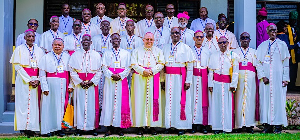
 Ghana Catholic Bishops' Conference says weakening family structures can have long-term social costs
The Ghana Catholic Bishops’ Conference (GCBC) has issued a public statement on national conversations around the anti-LGBTQ+ bill, responding to recent remarks attributed to President John Dramani Mahama and the Minister of State in charge of Government Communications Felix Kwakye Ofosu.
The bishops in the statement signed by the Bishop of Sunyani and President of the Ghana Catholic Bishops’ Conference, Most Rev Matthew Kwasi Gyamfi and dated Friday, April 10, 2026, said their intervention is guided by their role as spiritual leaders and citizens committed to Ghana’s moral and democratic development.
Mixed emotions as Ghanaians weigh in on anti-LGBTQ+ Bill
They have thus reacted to comments suggesting that LGBTQ+ related issues are not a national priority.
“We have taken notice of reports that the President, speaking at the World Affairs Council, described LGBTQ+ matters as ‘not the most important issue we face as a nation’,” portions of their statement read.
They also referenced Kwakye Ofosu’s remarks allegedly describing the debate as a “waste of time.”
“The Minister, in subsequent commentary, suggested that such matters are ‘not a major priority for Ghanaians,’ and further characterised the debate as a ‘waste of time’,” the GCBC stressed.
The bishops cautioned that such posturing risks dismissing issues that touch on identity, family, and social order.
They stressed that economic hardship in Ghana is real, but contended that moral questions cannot be separated from development.
“We readily acknowledge the weight of Ghana’s present challenges. Inflationary pressures strain households. Youth unemployment remains stubborn. Gaps in healthcare and education demand urgent reform.
“On these matters, the Church has spoken consistently and will continue to advocate policies that promote equity, opportunity, and human development. However, it is analytically unsound to frame a choice between economic progress and moral coherence,” it stated.
According to them, both economic growth and moral stability reinforce each other.
They argued that strong family systems contribute to social and economic development, citing education outcomes and social stability.
They further stated that weakening family structures can have long-term social costs.
“The two are not rivals but companions. Empirical social research across contexts shows that stable family structures correlate with improved educational outcomes, reduced crime rates, and greater economic mobility. The family, in quiet ways, is a nation’s most efficient social welfare system. To weaken the moral ecology of the family is to erode the very conditions that make sustainable development possible,” the group cautioned.
The bishops reiterated their understanding of family values stressing that “marriage is a lifelong union between one man and one woman”.
“By ‘family values,’ we refer to the understanding of marriage as a lifelong union between one man and one woman, ordered toward mutual good and the procreation and formation of children,” it stated.
The statement also reaffirmed two core principles of human dignity and protection of the family structure indicating that they must not be divided.
The bishops further condemned discrimination and violence against individuals, and at the same time, maintained their position on marriage and family as a union between a man and a woman.
“No individual, regardless of sexual orientation or identity, may be subjected to violence, hatred, or unjust discrimination. Such acts are moral failures and social wounds. We condemn them without reservation.
“Second, the legitimate responsibility of society to uphold and protect the institution of the family, founded upon the union of a man and a woman. This is not an act of exclusion but a recognition of a unique anthropological and social reality,” it added.
“To affirm dignity does not require the redefinition of marriage. To defend marriage does not require hostility. Where either principle is isolated, distortion follows,” the statement continued.
The group also addressed the Human Sexual Rights and Family Values Bill, urging consistency in political commitments and careful legislative review.
They called for broad national dialogue involving government, religious bodies, traditional authorities, and civil society.
“We therefore call upon all stakeholders, the executive, the legislature, religious leaders, traditional authorities, and civil society, to engage in dialogue marked by intellectual seriousness, mutual respect, and moral clarity. The tone of our discourse matters as much as its content. Words can either build a republic of trust or fracture it into suspicion,” it indicated.
'Anti-LGBTQ+ bill must be passed, otherwise I will not return to parliament' - NDC MP
The bishops emphasised that Ghana’s development path must balance economic goals with moral foundations.
MAG/VPO
RNAQ Divorce: Court awards ex-wife GH¢300k, dismisses GH¢50m settlement claim

Copyright © 1994 - 2026 GhanaWeb. All rights reserved.










