



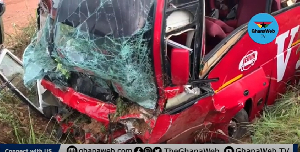
 File photo VIP bus involved in an accident
Legal analysts and practitioners are raising serious concerns over the equity of the National Insurance Commission’s (NIC) directive on the Limits on Motor Injury and Death Claims, known as CAP 2021.
Introduced to bring predictability to the insurance sector, the statutory framework faces intense scrutiny for potentially shortchanging third-party motor accident victims and their families.
In a detailed legal analysis published under the title “Limits on Motor Injury and Death Claims (Cap 2021): A Saving Grace or A Financial Leach” on The Law Platform, on June 8, 2026, legal minds, Jemima Ama Okai Esq. and Agatha Akpene Adom, broke down the policy rationale and systemic drawbacks of the directive, questioning whether it balances the scales of justice or merely protects corporate balance sheets.
The debate arrives on the heels of a devastating spike in road traffic accidents.
According to statistics from the National Road Safety Commission, 2025 recorded the highest death rate from road accidents in Ghana’s history, with 14,743 recorded crashes, 2,949 fatalities, 16,714 injuries, and 2,561 pedestrian knockdowns.
While the original intent behind the seminal Motor Vehicles (Third Party Insurance) Act of 1958 was to protect ordinary citizens against these exact financial ruinous events, critics argue CAP 2021 acts as a "financial leach" that shifts the economic burden of these crashes entirely onto victims.
Supporters of CAP 2021 maintain that the caps are a necessary regulatory anchor under the Insurance Act, 2021 (Act 1061).
Section 255(1) of the Act establishes that an insurance contract is void ab initio if the maximum liability is unknown at the time of signing.
By placing a ceiling on payouts, insurers can accurately price premiums, prevent business collapse, and maintain affordable insurance products for Ghanaian motorists.
The superior courts have also fortified this boundary. In the case of Edgar Kweku Wiredu Vs. National Insurance Commission [2025], the Court of Appeal ruled that the NIC possesses the full authority to issue these caps.
Watch as fuel tanker catches fire after accident on Nsawam-Accra Road
Crucially, the court clarified that an insurance company is not the wrongdoer (tortfeasor), stating: "The limits imposed in the CAP do not foreclose the right of a person who is injured or entitled to make a claim to seek further compensation against the tortfeasor... The cause of action of the person who has been injured is therefore first and foremost against the tortfeasor and not the insurance company."
This principle dates back to historical precedents like Akuffo V Issaka [1966], where the Supreme Court affirmed that victims could directly sue drivers and vehicle owners vicariously for full damages, including pain, suffering, and lost lifelong income.
Despite its legality, Okai Esq. and Adom argue that CAP 2021 completely bypasses the foundational legal principle of restitution in integrum; restoring an injured party to the position they would have been in had the damage not occurred.
The authors highlight two major statutory thresholds within CAP 2021 that fail to align with the current cost of living in Ghana:
• The GH¢1,000 Medical Cap: Under Section 6 of CAP 2021, if an accident victim cannot produce physical, formal receipts for medical treatment, their compensation is strictly limited to GH¢1,000.00. This aggressively penalizes everyday citizens who are oblivious to insurance bureaucracy or lose their paperwork during medical emergencies.
• The GH¢5,000 Funeral Cap: Section 7 of the directive fixes funeral expense compensation at a maximum of GH¢5,000.00. In Ghanaian culture, where final rites involve massive communal gatherings, feeding attendees, renting canopies, and purchasing coffins, this amount is drastically inadequate and often delayed by intense insurance scrutiny.
The systemic imbalance is exacerbated by a booming automotive market.
By 2022, Ghana had 3.2 million registered vehicles, and registrations surged an additional 34% between January and July 2025 alone with 149,440 new vehicles hitting the road.
Despite a flourishing premium pool, the analysis notes that the NIC has largely failed its statutory duty under Section 3(g) of Act 1061 to promote public awareness.
This lack of education violates the spirit of Article 23 of the 1992 Constitution, which demands administrative bodies act fairly, reasonably, and transparently.
To mend the fractured trust in the local insurance system, the legal analysts recommend that the NIC immediately implement a periodic review mechanism that ties compensation thresholds to inflation and shifting economic realities.
Until CAP 2021 actively prioritises human dignity alongside market solvency, it will continue to externalise the costs of tragedies, driving vulnerable families into poverty while failing the very public it was designed to protect.

Copyright © 1994 - 2026 GhanaWeb. All rights reserved.










