



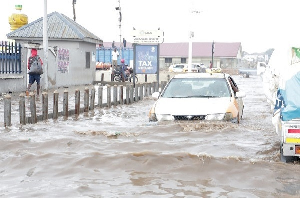
 Decades of unregulated development have destroyed the city’s natural flood-control systems
President of the Ghana Institution of Engineers, Ludwig Annang Hesse, has blamed Accra’s worsening flooding crisis on decades of poor planning, environmental degradation and irresponsible human activities, warning that the capital is heading towards disaster unless urgent action is taken.
Speaking on the city’s recurring floods, Hesse said flooding in Accra has become so predictable that no special warning is needed whenever it rains.
“These days, we do not need a prophet to tell us that when it rains, Accra will flood,” he said.
According to a report by myjoyonline.com on June 4, 2026, Hesse noted that flooding, which once occurred occasionally, has now become an annual reality in the capital.
“We used to experience floods once in a while — perhaps once in 10 years, five years or even 20 years. Today, we know with certainty that Accra will flood every year, whether it is during the rainy season or not,” he stated.
Hesse attributed the worsening situation to decades of unregulated development that have destroyed the city’s natural flood-control systems.
GhIE pushes for national runoff control policy to combat urban flooding
“For the past 30 or 40 years, we have done things the wrong way. We have filled all the water-retention areas and low-lying lands, and we have built in places where development should never have occurred,” he explained.
He warned that the destruction of natural retention areas has significantly accelerated the movement of rainwater into the city, increasing the risk of flooding.
“Water that once took about 12 hours to travel from Aburi to Accra now takes roughly an hour. The natural systems that slowed down the movement of water have been destroyed,” he noted.
Hesse further criticised indiscriminate dumping of refuse into drains and waterways, describing it as a major contributor to drainage problems across the capital.
“The drainage channels downstream, which are already operating beyond capacity, are filled with silt, rubbish and plastic waste,” he said.
He also lamented the continued encroachment on waterways and the destruction of key floodwater collection areas, citing communities including Sakumono, Teshie and Korle Lagoon as examples of reclaimed areas under pressure from development.
“If we continue on this path, we are heading towards a disaster,” he warned.
According to him, successive governments have focused heavily on expanding drainage infrastructure, an approach he believes has failed to address the root causes of flooding.
He proposed what he described as an ‘upstream’ flood management strategy, urging households to retain rainwater on their properties temporarily and release it gradually after peak flooding periods.
“This is the only realistic option left to address Accra’s drainage challenges and minimise flooding in the city,” he stated.
MRA/VPO
AROUND TOWN: Residents cry for help as heavy floods displace homes:

Copyright © 1994 - 2026 GhanaWeb. All rights reserved.










