



 The Sallah v Attorney-General case remains a cornerstone of Ghanaian judicial history
More than five decades after a landmark constitutional showdown, the Sallah v Attorney-General case [1970] GLR 55 remains a cornerstone of Ghanaian judicial history, illustrating the tensions between a newly elected civilian government and the judiciary's role in checking executive power.
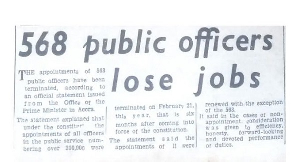
On February 21, 1970, the government of Prime Minister Kofi Abrefa Busia terminated the appointments of 568 public servants as part of implementing transitional provisions in the 1969 Constitution.
Letters were delivered nationwide, with Ghana Air Force planes assisting distribution outside Accra.
I will treat 'ungovernable Ghana comment' with contempt - Attorney General
Among those affected was EK Sallah, a manager at the Ghana National Trading Corporation (GNTC).
The government cited the need for greater efficiency, honesty, and forward-looking performance, arguing that retaining underperforming officials hindered national progress.
Busia, in a March 1970 Daily Graphic interview and reshared via X on June 2, 2026, by @obiMpenaAustine, acknowledged the human impact on families and long-serving employees but defended the move: "Should I allow those who have lost the ability to work hard and efficiently to stop the progress and development of the country while there are young and efficient people who can do the job?"
The terminations stemmed from Section 9(1) of the First Schedule's transitional provisions, which addressed appointments in public offices "established" by or under the National Liberation Council (NLC) following the 1966 coup.
The government interpreted this broadly as terminating thousands of public service appointments six months after the 1969 Constitution took effect.
DRIP Contract Dispute: J A Plant Pool challenges Attorney General's lawsuit
Sallah challenged his dismissal in the Supreme Court, seeking a declaration that his position fell outside the scope of the transitional provision and that the termination was unlawful.
He was represented by Lynes Quarshie-Idun and Company.
The case, heard by a five-judge panel (Justices Apaloo, Siriboe, Sowah, Anin, and Archer), quickly turned contentious.
Attorney General Nicholas Yaw Boafo Adade filed a motion to disqualify Justices Apaloo and Sowah for alleged bias.
The AG claimed Justice Apaloo was a close friend of Sallah and that Justice Sowah had a personal interest because his brother-in-law was also affected.
Witness testimony ensued, but the court found some government witnesses "dishonest and vicious," leading to perjury charges.
Sallah himself testified, admitting limited social contact with Justice Apaloo.
The majority ruled that the two justices could sit, applying the "real likelihood of bias" test.
Atta Akyea 'battles' Attorney General in court
Justice Siriboe dissented on the bias issue and later withdrew from the panel.
In the substantive decision delivered on 20 April 1970, a 3-1 majority (Justices Apaloo, Sowah, and Archer; Justice Anin dissenting) held that Sallah's appointment was wrongly terminated. The court interpreted "establish" in Section 9(1) according to its ordinary meaning to set up or create; ruling that the GNTC, formed by executive instrument in 1961 under the prior regime, did not fall under NLC-created offices subject to automatic termination.
The judges rejected broader interpretations, emphasising constitutional text over foreign theories like Kelsen's Grundnorm regarding revolutionary legal orders.
They also affirmed that the government (via the Attorney-General) could be sued. Costs were awarded against the state.
Prime Minister Busia responded firmly in a televised address. He stated that no court could compel the government to employ or re-employ anyone, describing such an attempt as a "futile exercise."
He invited others affected to sue if they wished but made clear the government would exercise its discretion in hiring.
PDS names Attorney General and ECG boss as witnesses to GH¢850 million ownership
Busia stressed he would not dismiss judges or create martyrs but rejected any supervisory judicial powers beyond the Constitution.
The Sallah v. Attorney General case is frequently cited alongside other seminal Ghanaian cases like Tuffuor v Attorney General as a defining moment in constitutional law.
It underscored judicial independence, strict interpretation of transitional provisions, and limits on executive actions in public service matters shortly after the return to civilian rule.
The ruling highlighted that not all public appointments were subject to the mass terminations, offering potential relief to others in similar positions.
Though the 1969 Constitution was later suspended in 1972, the case endures as a symbol of the judiciary's willingness to check executive overreach in post-independence Ghana.
VKB/VPO

Copyright © 1994 - 2026 GhanaWeb. All rights reserved.










