



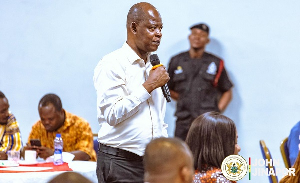
 Dr Steve Manteaw is the Chairman of the Ghana Extractives Transparency Initiative
Chairman of the Ghana Extractives Transparency Initiative (GHEITI), Dr Steve Manteaw, has slammed mining consultant Wisdom Gomashie for politicising issues related to the Ghana Gold Board’s (GoldBod) gold refinery agreement with Gold Coast Refinery and Rand Refinery.
This follows comments by Gomashie on his Facebook page questioning why GoldBod chose to sign a gold refinery agreement with Gold Coast Refinery, a private refinery in which GoldBod holds a 15 percent stake, instead of Royal Ghana Refinery, which he claims has a 20 percent stake held by the Bank of Ghana.
The content of Gomashie’s post suggests that political motives and personal gain may have influenced GoldBod’s decision to engage Gold Coast Refinery.
“RGR, in which Ghana holds a 20% stake through the Bank of Ghana, can process 400kg of gold daily, totalling about 2.8 tonnes weekly.
“It is a valuable state asset aimed at value addition for our gold. Meanwhile, the private Gold Coast Refinery processes just one tonne per week. So why are we investing a 15% stake there?” he wrote.
However, in a sharp rebuttal, Dr Manteaw questioned how a 20 percent Bank of Ghana stake in Royal Ghana Refinery makes it a government-controlled entity.
He described the assertion as “rubbish,” and questioned the interests behind Royal Gold Refinery.
“How can a 20% BoG stake in Royal Refinery make it government-controlled? How is that control exercised? Some rubbish I’m reading this morning. Forgive my intolerance, folks. It’s getting nauseating now, especially the talk of political and personal interests. Who doesn’t know the interests behind Royal Gold? Or maybe those are religious interests,” he quizzed.
According to him, government is not under any obligation to use a particular vehicle to achieve its policy objectives.
For Dr Manteaw, Gomashie’s recent commentary appears aimed at pushing political interests disguised as national interest.
“Feel free to do your work and ask questions as you deem fit, but avoid conjecture and mischief. Take your time and learn. A 20% stake in a venture can give one control only under certain conditions, which are not applicable here. Again, one can shelve Royal Gold for reasons that may not be apparent to you. Political and personal interests of a previous government in Royal Gold could be the reason for abandoning it. In any case, government is not under any obligation to use a particular vehicle to achieve its policy objectives,” he stated.
Meanwhile, President of the Ghana Chamber of Mines, Dr Ken Ashigbey, has described the GoldBod–Gold Coast Refinery gold refining agreement as a critical milestone in Ghana’s journey toward achieving London Bullion Market Association (LBMA) accreditation and deepening local value addition in the gold sector.
Speaking at the signing ceremony, he congratulated the Chief Executive Officer and Board of the Ghana Gold Board, as well as the Bank of Ghana and its Board, for their roles in bringing the landmark agreement to fruition.
He noted that the agreement marks only the beginning of a longer process aimed at entrenching gold refining in Ghana, stressing that the Chamber’s commitment to local refining goes beyond rhetoric.
According to him, the Chamber has actively engaged Gold Coast Refinery, Rand Refinery, and Royal Refinery as part of a deliberate strategy to build the technical and institutional foundations required for LBMA accreditation.
The Ghana Gold Board (GoldBod) on Tuesday, January 20, 2026, signed a landmark gold refining agreement with Gold Coast Refinery, marking a major step towards deepening value addition within Ghana’s gold sector.
The partnership seeks to reduce Ghana’s long-standing reliance on exporting raw gold, a practice that has historically resulted in significant revenue losses that could otherwise be captured through domestic refining and downstream processing.
Under the agreement, gold sourced from both artisanal and large-scale mining operations will be refined locally for trade and export, strengthening Ghana’s position along the global gold value chain.
NAD/MA

Copyright © 1994 - 2026 GhanaWeb. All rights reserved.










