



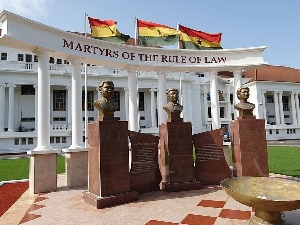
 Ghana's Supreme Court, the seat of the Judiciary, in shot | File Photo
The newly-passed Legal Education Reform Bill, 2025, has triggered one of the most important policy debates in the country’s legal and academic space in decades.
Designed to dismantle the long-standing monopoly of the Ghana School of Law and expand access to professional legal training, the bill has drawn strong reactions from politicians, jurists, and legal practitioners, revealing diverse views on access, quality, and institutional control.
This GhanaWeb article examines key Ghanaian public figures who have influenced the debates and what their positions reveal about the future of legal education in the country.
A reform targeted at equity and access
At the political level, the bill has been strongly defended by government leaders, particularly Mahama Ayariga, the Majority Leader in Parliament.
Speaking during parliamentary debates recently, he termed the reform as a fulfillment of a political promise to democratise legal education.
He argued that the bill promotes “equity, fairness, and broader access” to legal training.
Contributing to the debate before the adoption of the committee’s report, Mahama Ayariga, Majority Leader and Member of Parliament for Bawku Central, explained that the bill would provide the establishment of a National Council for Legal Education.
Ayariga stressed that the reforms would ensure a fair and equitable platform for qualified persons to enter the legal profession, thereby widening opportunities for aspiring lawyers across the country,” he stated.
Ayariga positioned it as a deliberate move to open opportunities beyond elite bottlenecks.
Parliament passes Legal Education Bill 2025
For the government, the reform is not just educational but a social justice policy, geared at breaking what has long been seen as an exclusionary system.
Minority Concerns: Reform without consultation?
On the opposing side, Alexander Kwamena Afenyo-Markin, Minority Leader in Parliament, raised broader political concerns during the debate.
While not rejecting the reform outrightly, he questioned government priorities and implementation consistency.
Speaking during a debate on the bill in Parliament on February 20, 2026, he stated that this “rendition of the Legal Education Bill 2025 is problematic” due to inconsistencies in the assessment by selected lecturers training students at separate times and are expected to coordinate later at a certain point.
More directly critical was veteran lawyer Sam Okudzeto, a former President of the Ghana Bar Association.
He argued that the reforms should have been referred to the Ghana Bar Association first.
“I had one complaint in the first place when this bill was proposed. The Ghana Bar Association (GBA) was not involved at all, which I thought was rather strange,” he said on JoyNews’ PM Express on April 1, 2026.
He argued that the nature of the reforms required direct input from the Bar.
“One would have thought that this matter should have been referred to the GBA for their input, because they are the members of the profession,” he added.
His position reflects concern about insufficient stakeholder consultation.
Practitioners in the legal space have argued for expanded access but cautiously. Within the judiciary, the debate has been more nuanced.
Retired Supreme Court judge William Atuguba has also contributed to the debate, stressing the purpose of legal education itself.
He argued that legal training should be practical and problem-solving oriented, not just theoretical.
Speaking in an interview on The Law Lab, on the new Legal Education Bill 2025, on April 1, 2026, Justice Atuguba highlighted that the system, rooted in legislation from 1968, was designed for a much smaller population and narrower professional landscape.
"The LLB has been treated as a purely academic course, but law is law. It should be directed at solving societal problems and geared toward practical application," he said.
Judicial perspectives largely agree on reform — but warn against uncontrolled expansion that could dilute standards.
Strong Criticism: Fears of politicisation and declining standards
Beyond Parliament and the bench, some legal analysts and commentators have raised deeper structural concerns.
'No Makola', National Bar Exams and More: What the Legal Education Bill 2025 brings
Critics of the bill point to provisions that create a new Council for Legal Education and Training with significant powers and places the Attorney-General in a central role, raising fears of executive influence.
Others have argued that the reforms could “open the floodgates” without sufficient safeguards.
They contend that it could:
- Risk commercialisation of legal education, especially among private institutions;
- May weaken the independence of legal training if regulatory bodies are politically influenced;
- They deem the bill as potentially transformative but also dangerously under-guarded.
The Central Issue: Access vs quality
Across all viewpoints, the debate converges on one fundamental tension:
1. Access (pro-reform camp)
Too many LLB graduates are locked out of professional training
The current system is elitist and restrictive
Reform aligns Ghana with global models (UK, US, Nigeria)
<2>. Quality (critical camp)
Rapid expansion risks producing under-trained lawyers
Weak regulation could lead to institutional decline
Political influence may undermine professional independence
What this debate reveals about Ghana
The range of voices from politicians to senior jurists shows that this is not a partisan issue. It is a systemic crossroads.
Government sees inclusion and opportunity, legal veterans see process and institutional integrity risks and judges see necessity but with caution.
Reform with consequences
The Legal Education Bill 2025 is widely acknowledged as historic. It ends decades of restricted access and redefines the pathway to becoming a lawyer in Ghana.
But the voices shaping the debate reveal a deeper truth: The real question is not whether reform is needed but whether Ghana can expand access without compromising standards and independence.
For students, the bill promises opportunity; for the legal profession, it raises existential questions; and for the country, it will determine the quality, integrity, and accessibility of justice for generations to come.
VPO/AE
'JJ Rawlings did not die of COVID 19' - Dr Nyaho Tamakloe

Copyright © 1994 - 2026 GhanaWeb. All rights reserved.










