



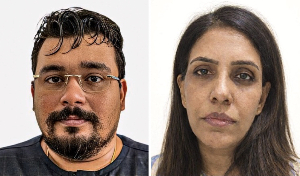
 Niharika Handa and her son (L) are in court with GhanaWeb
A High Court in Accra has upheld a pre-trial restriction on an investigative report alleging that an Indian woman used fraudulent means to obtain Ghanaian citizenship.
The court ruled that a report on GhanaWeb concerning Niharika Handa must be taken offline to prevent "irreparable damage" to her reputation before a full defamation trial.
Handa denies all allegations of wrongdoing.
The legal battle
The case centres on a September 2025 article which claimed Ms Handa fled India to evade arrest on fraud charges before illegally acquiring a Ghanaian passport.
Justice Adjenim-Boateng declined to discharge an earlier injunction, despite arguments from the defendants that their counsel was absent during the initial hearing due to a medical emergency.
The judge maintained that the restriction was necessary to protect the claimant’s standing while her substantive defamation claim is heard.
'Conflicting' records
However, recent court filings from March 2026 have introduced a series of documents that defence lawyers say directly contradict Handa’s claims.
According to these records, Handa has allegedly used at least five different years of birth across various official documents in Ghana, India, the UK, and Austria.
The filings point to what defense lawyers say is a stark discrepancy in 2025 - in Ghana she gave written statements listing her birth date as 14 September 1961 yet in the UK a sworn affidavit notarised in the same year and presented to an Indian court listed her birth date as 14 September 1965.
Further documents, including divorce papers, list a third date of birth in 1966. While Ms Handa has previously attributed such discrepancies to clerical errors, lawyers for the defendants argue the pattern suggests "deliberate misrepresentations."
Fugitive claims
The court has also received filings with details of rulings from the New Delhi High Court, whose 2019 decision described Ms Handa as a "fraud mastermind" who had absconded to avoid arrest.
This appears, according to defense lawyers, conflict with her statements to the Ghanaian court that she was "never a fugitive."
Questions have also been raised regarding her residency in Ghana. While Ms Handa claims she lived in the country continuously between 2017 and 2022 to meet citizenship requirements, Indian court records suggest she was in Dubai for medical treatment during part of that period.
The New Delhi court reportedly questioned the authenticity of those medical records at the time, calling a claim that she required three years of "bed rest" inherently improbable.
Press freedom concerns
The order for the story to be taken offline has sparked a backlash from media rights groups and civil society organisations.
Critics argue that the use of interlocutory injunctions to suppress investigative journalism sets a "dangerous precedent" and discourages reporting on matters of significant public interest.
The defendants had argued that the fresh evidence placed before the court justified lifting the restriction so the matter could be "tested at trial" without suppressing the original publication.
The case continues.

Copyright © 1994 - 2026 GhanaWeb. All rights reserved.










