



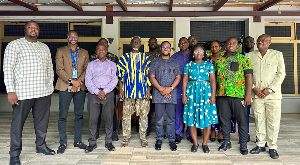
 UNDP Ghana holds maiden meeting on climate-smart rice project
Rice is a staple food for millions of Ghanaians and a vital source of livelihoods for farming households across the country. However, conventional irrigated rice cultivation is also one of the largest agricultural sources of methane emissions, a greenhouse gas significantly more potent than carbon dioxide.
As climate risks intensify and pressure on water resources increases, the need for climate smart, resource efficient agricultural practices has become more urgent than ever.
It is against this backdrop that the Promotion of Climate Smart Agriculture Practices for Sustainable Rice Cultivation in Ghana Project is redefining how rice is produced in the country. Implemented by the United Nations Development Programme in collaboration with the Government of Ghana under the Ghana–Switzerland bilateral cooperation framework pursuant to Article 6.2 of the Paris Agreement, the project promotes the adoption of the Alternate Wetting and Drying (AWD) irrigation technique as a scalable solution for climate mitigation and sustainable agriculture.
Alternate Wetting and Drying technique allows rice fields to dry intermittently rather than remain continuously flooded, improving water use efficiency, reducing methane emissions, and lowering production costs, while maintaining or, in some cases, increasing yields for farmers.
Beyond farm-level benefits, the project directly contributes to Ghana’s Nationally Determined Contributions and supports the generation of Internationally Transferred Mitigation Outcomes, creating opportunities for results-based climate finance linked to verified emission reductions.
A key milestone in the implementation of the project was marked with the maiden meeting of the Project Steering Committee, the project’s highest governance and decision-making body. The meeting brought together representatives from relevant government institutions, farmer-based organisations, research and technical institutions, civil society, and development partners.
The Project Steering Committee provides strategic direction, policy oversight, and accountability to ensure effective, inclusive, and results-oriented implementation of the project. Its mandate includes reviewing project progress, approving annual work plans and budgets, addressing implementation risks, promoting coordination across sectors, and supporting the scaling of successful AWD practices nationwide.
Speaking at the meeting, Abdul-Razak Saeed, Head of Environment and Climate at UNDP Ghana, underscored the importance of strong governance arrangements in delivering credible climate outcomes:
“Climate smart solutions such as Alternate Wetting and Drying offer Ghana a practical pathway to reduce emissions while strengthening farmer livelihoods. The establishment of the Project Steering Committee is a critical step in ensuring national ownership, accountability, and measurable impact as we scale sustainable rice production across the country.”
As Ghana advances toward a more climate resilient and low emissions agricultural future, the Promotion of Climate Smart Agriculture Practices for Sustainable Rice Cultivation in Ghana Project demonstrates how innovation, partnership, and effective governance can work together to deliver solutions that benefit farmers, communities, and the climate.
The Project Steering Committee consists of representatives from the following institutions:
• Ministry of Environment, Science and Technology (MEST)
• Environmental Protection Authority (EPA)
• Ministry of Food and Agriculture (MoFA)
• Ghana Irrigation Development Authority (GIDA)
• Water Resources Commission (WRC)
Docusign Envelope ID: 9F2F74B9-DE66-41FF-9A6D-CC25FCF4A1B2
• Ghana Rice Inter-professional Body (GRIB)
• Farmer Based Organisations (FBOs) representing AWD participating irrigation schemes
• International Water Management Institute (IWMI)
• CSIR-Savanna Agriculture Research Institute (CSIR-SARI)
• Women in Law and Development in Africa (WiLDAF Ghana)
• Strategic Youth Network for Development (SYND)
• United Nations Development Programme (UNDP)

Copyright © 1994 - 2026 GhanaWeb. All rights reserved.










