



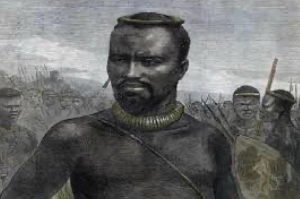
 An illustration of King John Aggrey Essien, who rebelled against the British colonial rulers
Long before organised nationalist movements gathered momentum in the Gold Coast, one traditional ruler stood at the center of resistance to colonial domination — and paid a heavy price for it.
King John Aggrey Essien of Oguaa (Cape Coast) is remembered not only as a fierce challenger of British authority, but as the first Ghanaian king to be exiled for opposing colonial rule.
His exile to Sierra Leone in 1867 marked a historic turning point in Ghana’s anti-colonial struggle, making him one of the earliest political martyrs of British imperialism and a forerunner of later resistance movements.
Though often overlooked in mainstream historical narratives, King John Aggrey occupies a distinguished place among the heroes of the Gold Coast for transforming traditional authority into a platform for political defiance.
Born around 1809 in Cape Coast, John Aggrey was the son of King Joseph Aggrey, also known as Burupu, who ruled during a period of mounting political unrest in the coastal town, then the nerve centre of British administration in the Gold Coast.
Following his father’s death in 1851 and subsequent succession disputes involving King Kofi Amissa, Cape Coast became embroiled in tensions over indigenous authority and colonial interference.
Against this backdrop, John Aggrey was elected king in February 1865, a choice later approved by Governor Richard Pine.
His enstoolment was itself remarkable, with colonial records noting it took place “for the first time in the annals of Cape Coast” without the usual pomp associated with royal installations.
But his reign would be defined not by ceremony, but by confrontation.
The king who refused colonial submission
King John Aggrey became one of the most outspoken critics of British encroachment on African sovereignty.
He challenged the legitimacy of British jurisdiction, resisted the transfer of cases from his court to colonial courts, and rejected the notion that the people of Cape Coast were subjects of the British Crown.
He also reportedly refused to sign over lands surrounding Cape Coast Castle to the British — a bold act of resistance at a time when colonial power was steadily expanding.
Aligning with educated African elites, he became a rallying figure in the intensifying coastal resistance of the 1860s, insisting that traditional authority could not be subordinated to foreign rule.
His unyielding opposition would ultimately provoke a dramatic response.
In 1867, the British authorities apprehended King John Aggrey and banished him to Sierra Leone, making him the first known Ghanaian monarch to be exiled by colonial authorities.
The move was unprecedented.
Even the British Home Government reportedly had reservations about the legality of his removal, with concerns raised over the absence of proper authority to try or detain him in Sierra Leone.
Yet he remained in exile for two years, from January 1867 to March 1869, far from his kingdom and people.
Only when he fell seriously ill was he hurriedly returned to Cape Coast.
His forced exile, however, had already entered history as one of the earliest examples of colonial repression directed at a Ghanaian ruler.
Upon his return, a weakened King John Aggrey renounced his claim to the stool and was granted an annual pension of £100 for life, subject to what colonial authorities termed “good behaviour.”
He lived the rest of his short remaining life as a private citizen and died later in 1869.
But his removal had consequences far beyond his own fate.
Historians regard the treatment meted out to him as one of the factors that helped galvanize support for the formation of the Fante Confederation, one of the earliest organized African responses to colonial domination.
His exile became not a defeat, but a spark.
As British power expanded, so too did African resistance — and King John Aggrey’s sacrifice helped shape that awakening.
Though history has too often consigned him to the margins, King John Aggrey Essien remains a towering symbol of courage and constitutional resistance.
Before nationalist politics had a name in the Gold Coast, he was already challenging imperial authority, defending indigenous sovereignty, and paying for it with banishment.
His story is not merely that of a Cape Coast king who confronted British rule.
It is the story of Ghana’s first exiled king — a monarch whose punishment became a powerful chapter in the long road to freedom.

Copyright © 1994 - 2026 GhanaWeb. All rights reserved.










