



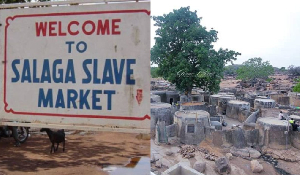
 File photo of the sign post of Salaga Slave Market
Northern Ghana holds some of the most important yet often overlooked sites connected to the trans-Saharan and trans-Atlantic slave trades.
Long before captives reached the coastal forts, many endured harrowing journeys through inland routes that began in the north.
These routes, marked by slave markets, holding camps, and transit points, formed part of a vast network that moved enslaved people from the interior of West Africa toward the coast.
Salaga: The Market at the Centre of It All
At the heart of this history is Salaga, once one of the largest slave markets in West Africa.
Historical records and heritage reports indicate that Salaga served as a major commercial hub in the 18th and 19th centuries, where enslaved people were traded alongside kola nuts, textiles, and livestock. Caravans from regions such as present-day Burkina Faso and Mali converged here before continuing southward.
Today, remnants such as the “slave wells” dug to provide water for captives still stand as silent witnesses to this past.
Pikworo and the Holding Camps
Further north lies Pikworo Slave Camp near Paga, another key site along the route.
Archaeological and tourism documentation show that Pikworo functioned as a resting and holding camp for enslaved people. Prisoners were kept in rock enclosures, often chained and guarded, before being moved onward.
Inside Ghana's UN Slavery Motion: What it takes to pass or fail
Nearby features such as the “last bath” sites, where captives were washed before departure, spotlight the dehumanising processes they endured.
The Long March South
From these northern centres, enslaved people were forced to march hundreds of kilometres through forest and savannah toward the coast. The journey could take weeks or months, with many dying along the way due to exhaustion, disease, or abuse.
Scholars of African history note that these inland routes were critical to sustaining the coastal slave trade. Without them, the supply of captives to European traders at the coast would not have been possible.
Arrival at the Coastal Forts
The final leg of the journey led to major coastal slave forts such as Cape Coast Castle and Elmina Castle.
Here, captives were held in dungeons before being shipped across the Atlantic. According to historical accounts documented by UNESCO and the Ghana Museums and Monuments Board, these forts were central nodes in the trans-Atlantic slave trade, linking inland capture routes to global trafficking networks.
A Shared but Painful Heritage
The northern slave routes remind us that slavery in Ghana was not confined to the coast. Communities across the north were deeply affected through raids, forced marches, and the loss of generations of people.
Why US voted against Ghana's resolution to declare slavery a crime against humanity
Research and heritage preservation efforts highlight how local leaders, traders, and external forces all played roles in sustaining the system.
Preserving the Memory
Today, sites like Salaga and Pikworo are being preserved as heritage and educational centres. They serve as places of reflection, helping visitors understand the scale and human cost of slavery.
Government and cultural institutions in Ghana, along with international partners, continue to promote these sites as part of a broader effort to document and teach this history.
Why It Matters Today
Understanding the slavery routes from northern Ghana offers a more complete picture of the past. It shifts the narrative beyond coastal castles and reveals the long, painful journeys endured inland.
As historians and educators emphasise, remembering these routes is not only about the past—it is about acknowledging resilience, confronting historical truths, and ensuring such injustices are never repeated.
VPO/SEA
A Plus Bares It All: From politics to showbiz and beyond

Copyright © 1994 - 2026 GhanaWeb. All rights reserved.










