



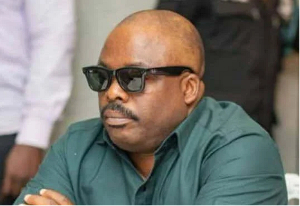
 Dr Callistus Mahama is the Executive Secretary to President John Dramani Mahama
The Executive Secretary to President John Dramani Mahama, Dr Callistus Mahama, has raised concerns over what he describes as premature discussions about the 2028 presidential succession.
In an opinion piece on graphic.com.gh on Tuesday, May 5, 2026, he warned that shifting attention to future political ambitions could distract from the government’s ongoing efforts to stabilise the country and deliver on its mandate.
Dr Callistus Mahama speaks on public debates over Mahama's use of brother's jet
He noted that when President Mahama assumed office in January 2025, Ghana was facing serious economic challenges that required urgent attention and focus.
He stressed that the work of recovery is still ongoing and should not be overshadowed by early political positioning.
“Barely a year and a half into this mandate, it is sobering to reflect on how quickly attention can drift. The conversation, subtle as it may be in some quarters, about succession in 2028 risks arriving before the foundations of recovery have even been firmly laid,” he said.
Dr Mahama pointed out that the current administration still has more than two and a half years to fulfil its promises to Ghanaians.
He cautioned that turning attention away from governance to succession planning at this stage could affect performance and public trust.
“To turn, even partially, from that task toward personal political calculations is not just premature; it is a quiet form of neglect,” he stated.
He also highlighted concerns within the National Democratic Congress (NDC), indicating that the party has not yet completed its internal electoral processes.
According to him, leadership must emerge through established structures and not through early manoeuvring.
“Leadership, if it is to endure, must emerge from this order, not from anticipation of it, and certainly not from attempts to outpace it,” he noted.
Dr Mahama further addressed public office holders, urging them to prioritise their responsibilities over personal ambition.
He said holding public office requires full commitment and focus, especially at a time when the country is working to recover.
“The pursuit of personal ambition, when it begins to compete with the demands of governance, creates a quiet erosion of performance, discipline, and ultimately trust,” he said.
He warned that the government’s reset agenda remains fragile and could be affected if attention is divided.
“To fragment that focus, to reduce it to parochial platforms or emerging factions, is to place the entire effort at risk,” he added.
Dr Mahama concluded by stressing that the focus should remain on delivery rather than future elections.
“The question before us is not who leads in 2028. The question is whether, by 2028, we would have delivered enough,” he stated.
Read his full opinion piece below:
Before the race begins; A call for discipline, reflection, and duty - Callistus Mahama writes
There is a quiet danger that sometimes creeps into political life, not with noise, but with whispers. It begins subtly, like a conversation here, a suggestion there, and a quiet alignment of interests. Before long, attention shifts from the work at hand to the question of “what comes next.” That moment appears to be approaching far too early.
When John Dramani Mahama took office in January 2025, the country stood at a difficult crossroads. The economic headwinds were not abstract; they were real, immediate, and deeply felt by ordinary Ghanaians. Expectations were high, but so too were the constraints. The task before his administration was not simply to govern, but to steady a nation, restore confidence, and chart a credible path forward. That work is still underway.
Barely a year and a half into this mandate, it is sobering to reflect on how quickly attention can drift. The conversation, subtle as it may be in some quarters, about succession in 2028 risks arriving before the foundations of recovery have even been firmly laid.
The weight of the present moment
Governance, especially in times of recovery, demands concentration. It demands a certain humility - the recognition that the work before us is larger than any one individual’s future ambitions.
President Mahama still has more than two and a half years to deliver on the commitments made to the Ghanaian people. Those years are not excess time; they are the core of the mandate, that is to say, what is done or left undone within this period will shape not only the judgment of this administration, but the credibility of those who may seek to lead after it. To turn, even partially, from that task toward personal political calculations is not just premature; it is a quiet form of neglect.
A party yet to complete its own journey
Within the National Democratic Congress, the internal democratic journey is itself incomplete. At the most basic level, the branch, the party has yet to renew its structures through elections. From there will come the constituency, regional, and ultimately national processes.
These are not procedural formalities; they are the lifeblood of the party’s legitimacy. Leadership, if it is to endure, must emerge from this order, not from anticipation of it, and certainly not from attempts to outpace it.
There is something deeply instructive in this moment: even the foundation has not yet been settled, yet thoughts are already drifting to the summit.
The burden of responsibility
For those entrusted with roles in government, the obligation is even clearer and heavier.
Public office is, at its core, a trust. It demands presence, attention, and a full measure of commitment. It does not lend itself easily to divided focus. The pursuit of personal ambition, when it begins to compete with the demands of governance, creates a quiet erosion of performance, discipline, and ultimately trust. It must be said plainly: those who cannot subordinate ambition to duty risk doing injustice to both.
And where that tension becomes irreconcilable, there is honour, not weakness, in stepping aside. The nation deserves full service; ambition deserves honest pursuit. The two must not be confused.
The fragility of a national reset
The reset agenda that underpins this administration is not indestructible. It is fragile in its early stages and depends on consistency, discipline, and collective alignment. It requires that those entrusted with responsibility act not as individuals advancing separate interests, but as custodians of a shared national project.
To fragment that focus, to reduce it to parochial platforms or emerging factions, is to place the entire effort at risk. Nations have lost momentum this way before: not through dramatic failure, but through gradual distraction.
A time for reflection, not positioning
There will be a time, inevitably, for leadership contests, for ideas to be tested, for ambition to find its proper expression. That time will come through the party's structures and the rhythms of the democratic process. But this is not that time.
This is a time for quiet discipline, for reflection, for work that is often unglamorous but essential, and for an understanding that the legitimacy of tomorrow’s leadership will be built on the integrity of today’s service.
Dr Callistus Mahama appointed as Ag. Head of the Local Government Service
Conclusion
There is something sobering in recognising how easily focus can be lost, not through crisis, but through premature anticipation. The question before us is not who leads in 2028. The question is whether, by 2028, we would have delivered enough, done enough, steadied enough, to justify the trust that was placed in this administration in 2025.
Discipline is what will answer that question. The clock is not yet ticking toward succession; it is ticking toward delivery, and for now, discipline must prevail over ambition.
MAG/VPO
'We are happy to have Fatawu' – Kendrick Yehowada on new partnership

Copyright © 1994 - 2026 GhanaWeb. All rights reserved.










