



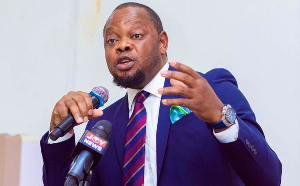
 Dr Justice Srem-Sai is the Deputy Attorney General and Minister of Justice
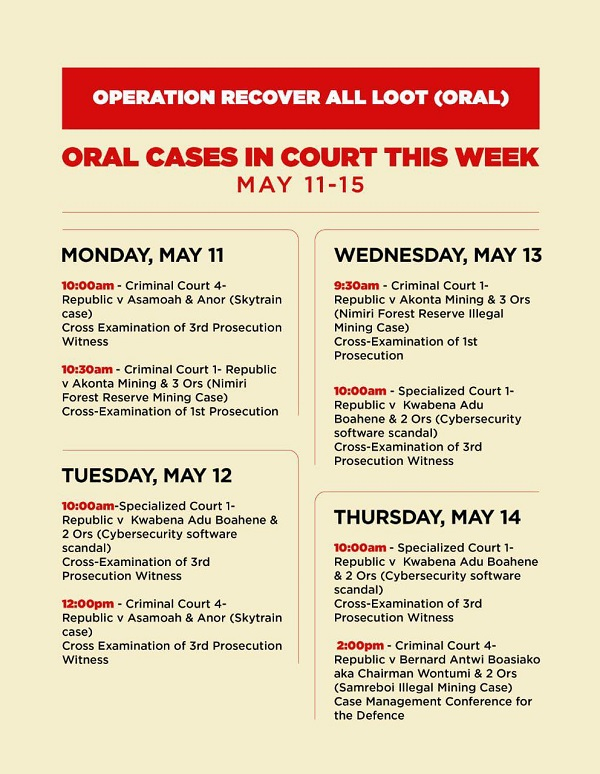
Several major cases involving illegal mining and the cybersecurity software scandal will go before the courts this week as part of the government’s efforts to curb corruption under the Operation Recover All Loot (ORAL) initiative.
The cases, scheduled between Monday, May 11, and Thursday, May 14, 2026, will feature cross-examinations of prosecution witnesses in ongoing trials.
'ORAL unconstitutional and ineffective' - Suame MP slams initiative
On Monday, May 11, 2026, the Republic v Asamoah & Anor (Skytrain case) is listed at Criminal Court 4 at 10:00 am for cross-examination of the 3rd prosecution witness. At 10:30 am, Criminal Court 1 will hear cross-examination of the 1st prosecution witness in the Republic v Akonta Mining & 3 Ors (Nimiri Forest Reserve Illegal Mining case).
Tuesday, May 12, 2026, will see the Republic v Kwabena Adu Boahene & 2 Ors (cybersecurity software scandal) at Specialised Court 1 at 10:00 am for cross-examination of the 3rd prosecution witness. The Skytrain case returns to Criminal Court 4 at 12:00 pm for further cross-examination.
On Wednesday, May 13, 2026, the Akonta Mining case continues at Criminal Court 1 from 9:30 am, while the cybersecurity case proceeds at Specialized Court 1 at 10:00 am.
The cybersecurity case also continues on Thursday, May 14, 2026, at 10:00 am at Specialised Court 1. At 2:00 pm, Criminal Court 4 will hold a case management conference for the defence in the Republic v Bernard Antwi Boasiako aka Chairman Wontumi & 2 Ors (Samreboi Illegal Mining case).
Deputy Attorney General and Minister of Justice, Justice Srem-Sai, in an update on the cases on his Facebook on Monday, May 11, 2026, said the cases form part of efforts to recover state resources.
According to him, the government has, within a short period in office, advanced the rights of citizens, noting improvements in how citizens exercise their rights.
“This NDC government has advanced the civil and political rights of citizens considerably within its 16 months in office.
“Today, citizens habitually exercise their right to demonstrate and hold protests freely, even right in front of the seat of the President, the Flagstaff House. That place was, for years before the return of President John Mahama, treated as a no-go zone for public protest - often resulting in extreme armed brutality to protesters,” he said.
Speaking on improvements in the country’s justice system, he said accused persons are now being processed in court within the constitutional time limit, while state prosecutors are taking a more flexible approach to bail applications.
“Today, accused persons are habitually presented before the court ahead of the constitutional deadline of 48 hours. State prosecutors habitually refrain from opposing bail applications in courts, and are increasingly focused more on the conditions of bail, which will secure the presence of accused persons at trial,” Srem-Sai said.
The deputy minister also noted that suspects now have better access to legal representation, with law enforcement agencies increasingly scheduling interrogations in advance to make it easier for lawyers to meet their clients.
‘I cannot pressure the courts to fast-track cases’ - Mahama on delays in ORAL prosecutions
“Suspects’ access to legal counsel has also seen a major improvement. Our police, law enforcement and investigative agencies now, in appropriate cases, habitually schedule interrogations ahead of time. That way, lawyers do not have to spend long hours at detention centres to have access to suspects,” he stated.
MAG/VPO
Stakeholders mark May 9 Anniversary with strong anti-violence message

Copyright © 1994 - 2026 GhanaWeb. All rights reserved.










