



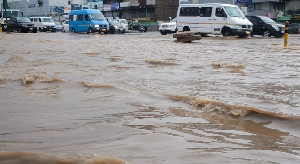
 A photo file of flooding situation in Ghana
Governance Expert and Lecturer at the Institute of Local Government Studies, Felix Agyei Amakye, has called for an integrated metropolitan governance frameworks to help tackle persistent flooding, traffic congestion, waste management challenges and unplanned urban growth across Ghana's major cities.
In a statement released after the Built Environment Professionals Breakfast Roundtable on Wednesday, June 10, 2026, Amakye stated that many of the challenges confronting Ghana's metropolitan areas, including traffic congestion, flooding, waste management, unplanned urban growth and inadequate infrastructure, require coordinated planning and management across multiple jurisdictions rather than isolated interventions by individual assemblies.
"Many of the challenges confronting Ghana's metropolitan areas, including traffic congestion, flooding, waste management, unplanned urban growth and inadequate infrastructure, cannot be effectively addressed by individual assemblies acting in isolation," he said.
The meeting held under the theme "Greater Metropolitan Area Management in Ghana: Towards Integrated Planning, Governance and Infrastructure Delivery," brought together engineers, architects, planners, surveyors, governance experts and urban development practitioners to deliberate on practical solutions for managing Ghana's rapidly expanding metropolitan areas, including Greater Accra, Greater Kumasi and Greater Sekondi-Takoradi.
The forum was jointly organised by the Ghana Institution of Engineering (GhIE), Ghana Institute of Architects (GIA), Ghana Institute of Planners (GIP) and Ghana Institution of Surveyors (GhIS).
Participants observed that while decentralisation has increased the number of Metropolitan, Municipal and District Assemblies (MMDAs), it has also resulted in fragmented governance structures that often hinder coordinated planning, service delivery and infrastructure development across contiguous urban areas.
They emphasised that Ghana's growing urban centres require governance systems that transcend administrative boundaries and facilitate collaboration among local authorities, government agencies, traditional authorities, the private sector, civil society organisations and citizens.
The participants further advocated long-term metropolitan planning, improved land-use management, integrated transportation systems, climate-resilient infrastructure and stronger enforcement of development regulations to support sustainable urban growth.
The forum also called on the Inter-Ministerial Coordinating Committee on Decentralisation (IMCC) to undertake broader stakeholder consultations on proposed local governance reforms, particularly regarding the creation and classification of Metropolitan, Municipal and District Assemblies in relation to emerging metropolitan governance challenges.
At the end of the meeting, participants agreed to develop a Joint Position Paper on Greater Metropolitan Area Management in Ghana to provide policy recommendations aimed at strengthening metropolitan governance, improving infrastructure delivery, enhancing urban resilience and supporting sustainable development.
They also agreed to establish a collaborative platform to facilitate continued engagement on metropolitan governance and urban development issues.
ANAS/VPO
BREAKING: Two rescued, one in critical condition after building collapse at Avenor

Copyright © 1994 - 2026 GhanaWeb. All rights reserved.










