



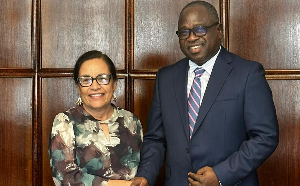
 Ghana's Seidu Issifu President of Marshall Islands, Dr Hilda Heine at the Forum in Berlin
Ghana and the Republic of the Marshall Islands have reaffirmed their commitment to advancing global climate action and protecting vulnerable communities from the impacts of climate change, including sea-level rise and climate-induced displacement.
The commitment was made during a high-level bilateral meeting between Ghana's Minister of State for Climate Change and Sustainability, Seidu Issifu, and the President of the Republic of the Marshall Islands, Dr Hilda Heine, on the sidelines of the Berlin Climate Mobility Forum in Germany.
The meeting highlighted the growing cooperation between African coastal nations and Pacific Small Island Developing States (SIDS), which are among the regions most vulnerable to climate-related threats such as coastal erosion, flooding, sea-level rise and forced displacement.
Ghana renews commitment to joint fight against galamsey with Côte d'Ivoire
Both leaders agreed to strengthen collaboration and amplify the voices of climate-vulnerable countries in global climate discussions.
Ghana, which currently chairs the Climate Vulnerable Forum (CVF) and the Vulnerable Twenty (V20) Group, and the Marshall Islands, a leading member of the High Ambition Coalition (HAC), pledged to work together to advance climate resilience and sustainable livelihoods.
The two countries also reaffirmed their commitment to advocating increased adaptation finance, enhanced support for loss and damage, and dignified pathways for climate mobility to ensure vulnerable communities are not left behind.
During the meeting, Issifu outlined key priorities for strengthening global climate resilience, including the full operationalisation and replenishment of the Loss and Damage Fund with direct access for vulnerable countries.
He also called for expanded anticipatory financing through initiatives such as the V20-G7 Global Shield against Climate Risks and the integration of climate mobility considerations into Nationally Determined Contributions (NDCs) and National Adaptation Plans (NAPs).
According to him, climate mobility should be recognised not merely as a humanitarian issue but as a critical component of long-term climate resilience and adaptation planning.
The Minister further highlighted Ghana's progress in developing a carbon market framework under Article 6 of the Paris Agreement.
He noted that Ghana has established bilateral agreements with countries including Switzerland, Sweden and Singapore to support the authorisation of Internationally Transferred Mitigation Outcomes (ITMOs), while innovative mechanisms such as the Communities Climate Adaptation Facility (C-CAF) are being explored to ensure carbon finance directly benefits local communities.
Issifu said the Office of the Minister of State for Climate Change and Sustainability is working to position Ghana as a bridge between climate vulnerability and sustainable prosperity.
He added that the government remains committed to strengthening climate governance and ensuring climate finance reaches district assemblies, local authorities and traditional leaders who are on the frontlines of climate adaptation.
"Ghana and the Marshall Islands share the same ocean, different coastlines, but one fight," Issifu stated.
He described the Marshall Islands as an important partner within the V20 network as Ghana continues to champion the interests of climate-vulnerable countries globally.

Copyright © 1994 - 2026 GhanaWeb. All rights reserved.










