



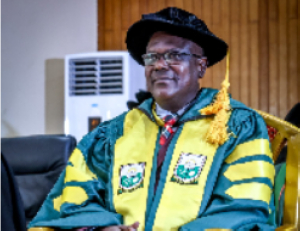
 Professor Christian Kwaku Amuzuvi, first full Prof of Electrical and Electric Engineering in Ghana
Correspondence from the Western Region
The government has been urged to remove taxes on residential rooftop solar photovoltaic (PV) systems to encourage widespread adoption and accelerate Ghana's transition to clean energy.
The call was made by Prof Christian Kwaku Amuzuvi, the first full professor of Electrical and Electronic Engineering in Ghana, during his inaugural lecture at the 13th Professorial Inaugural Lecture of the University of Mines and Technology (UMaT), Tarkwa.
Prof. Amuzuvi argued that Ghana could replicate the success of the country's Liquified Petroleum Gas (LPG) adoption programme to drive the uptake of solar energy in homes.
His lecture was delivered on the theme: “Driving the Green Energy Transition: Translating Ghana’s LPG Adoption Model to Residential Rooftop Solar PV Systems.”
According to Prof. Amuzuvi, solar technology has become increasingly affordable and competitive globally, making it an ideal time for Ghana to invest heavily in renewable energy solutions.
The professor noted that the initial fears and challenges associated with LPG adoption in Ghana had largely disappeared due to sustained public education and government support, resulting in widespread acceptance of the technology.
Just as we did for the LPG national programme, and now today every home has several cylinders, we are no longer afraid of it. Education has gone on, people have been attracted to use it, and now even if prices increase, many will still go for it because they know how good it is,” he said.
Prof. Amuzuvi stressed that a similar approach could be adopted for residential rooftop solar systems to make clean energy accessible to more households.
He proposed that government temporarily removes all taxes on solar PV systems for a period of five to seven years to encourage investment and consumer confidence.
“Government, remove all the taxes. For a start, just remove them. Within five or seven years, once people buy into it, you can gradually increase them and begin to generate revenue. But for now, let's remove the taxes and you will see how many Ghanaians will go for this system,” he emphasized.
The engineering professor further suggested that households with larger solar installations could generate excess electricity and sell it to neighbouring homes, creating new economic opportunities while improving energy security.
He, however, underscored the need for effective regulation by the Energy Commission to ensure standards and safety in the growing solar energy sector.
“The Ghana Energy Commission should come in and regulate this so that people will not just do anything,” he noted.
Prof. Amuzuvi highlighted both the environmental and economic benefits of solar energy, explaining that although homeowners may spend several years recovering their investment costs, the systems typically have much longer operational lifespans.
“After five, six or seven years, you pay for the system. But the system can last for about 15 years and beyond. Once you have paid for it, the rest becomes profit for you,” he said.
He added that increased adoption of solar energy would reduce dependence on conventional power sources, promote the use of clean natural resources and contribute significantly to environmental sustainability.
The lecture formed part of UMaT’s academic tradition of showcasing the research contributions and expertise of newly promoted professors.
Prof. Amuzuvi is recognized as the first full Professor of Electrical and Electronic Engineering at UMaT and among the leading advocates for renewable energy development in Ghana.

Copyright © 1994 - 2026 GhanaWeb. All rights reserved.










