



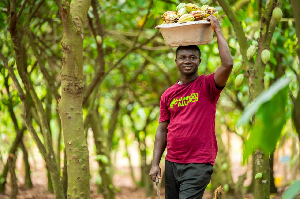
 Farmers, local authorities, and businesses across Ghana planted 1.3 million trees in 2025
In 2025, farmers, local authorities, and businesses across Ghana planted 1.3 million trees and brought more than 181,000 hectares of cocoa-growing landscapes under sustainable management, positioning the country as one of the strongest examples of regenerative agriculture in action, according to the Rainforest Alliance's newly released 2025 Annual Report, Regeneration Takes Root.
The achievements were delivered through the Rainforest Alliance's EU LEAN project, which brought farmers, local government, and private companies together through eight landscape management boards to coordinate restoration efforts across cocoa-growing communities.
The initiative reflects a growing shift beyond conserving natural resources toward actively restoring degraded landscapes while strengthening rural livelihoods.
"Protecting nature remains essential, but the future also depends on our ability to regenerate it," said Nicholas Jengre, Country Director of Rainforest Alliance Ghana.
Undersea cable cut disrupts internet services in Ghana - MTN
"Across Ghana, we are seeing what regeneration looks like in practice: healthier soils, trees returning to farms, landscapes managed collectively, and communities taking a leading role in shaping a more resilient future. What gives us hope is seeing farmers and communities not only adapt to change but actively shape it."
Ghana's progress is one of several examples highlighted in the Rainforest Alliance's 2025 Annual Report, which documents how regenerative agriculture and landscape restoration are improving both ecosystems and farmer livelihoods across West and Central Africa.
In neighbouring Côte d'Ivoire, where cocoa provides the main source of income for millions of households, nearly 87 percent of cocoa-producing families still earn below living income benchmarks.
Through the Hershey Income Accelerator Program (HIAP), implemented with technical partners, participating farmers are building more productive and resilient farms.
By 2025, 89 percent had completed the first year of their Farm Enterprise Plans, while HIAP demonstration plots produced approximately 34 percent more cocoa pods per 20 trees than comparable farms outside the programme.
Meanwhile, in Cameroon's Western Highlands, communities worked with the Rainforest Alliance between 2020 and 2025 to restore sacred forests threatened by deforestation and land degradation. The project established eight community nurseries, planted nearly 80,000 trees and restored more than 3,000 hectares of degraded land.
"Climate change is not imaginary, it's real," said Jean Louis Mva Ze, a cocoa farmer and cooperative president from Cameroon. "We all need to adapt, protect the forest, focus on the land we already have, and apply good practices. That's how we'll increase yields, attract partners, and secure our future."
The regional initiatives contribute to a broader global effort outlined in the report.
Across 80 landscape and community programmes and certification activities in 64 countries, the Rainforest Alliance reported helping protect or restore 11.9 million hectares of ecosystems, avoiding or sequestering 5.5 million metric tonnes of greenhouse gas emissions, and contributing US$2.22 billion in additional farm income through higher yields and sustainability premiums.
More than 10.8 million farmers and workers also received information on their rights and responsibilities during the year.
The report comes as agriculture continues to account for an estimated 80 percent of tropical deforestation globally, while climate change is projected to reduce agricultural production by as much as 35 percent by 2050.
Against that backdrop, the Rainforest Alliance says 2025 marked an important milestone with the launch of its new Regenerative Agriculture Standard—a science-based framework comprising 119 requirements covering soil health, biodiversity, water stewardship, climate resilience and social outcomes.
"Last year showed us what's possible when farmers are supported, and companies move beyond compliance toward regenerative investments," said Santiago Gowland, CEO of the Rainforest Alliance.
"Accelerating regenerative agriculture comes down to trust, and trust is earned with credible, demonstrable evidence. Our new Regenerative Agriculture Standard ensures impact on soil, biodiversity and livelihoods is measured and verified, not just claimed."
While highlighting measurable progress, the Rainforest Alliance says scaling regenerative agriculture will require sustained investment from governments, businesses and financial institutions to support farmers and communities leading the transition to healthier, more resilient landscapes.
The report notes that Rainforest Alliance Certified products are now available in 172 countries across more than 66,000 products, reflecting growing market demand for responsibly produced commodities.
Totobi Quakyi shares untold story of Rawlings' encounter with serial caller on live radio

Copyright © 1994 - 2026 GhanaWeb. All rights reserved.










