



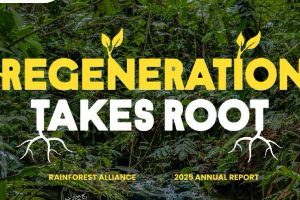
 The Rainforest Alliance Releases 2025 Annual Report
With global agriculture driving 80 percent of tropical deforestation and climate change threatening to reduce global agricultural production by up to 35 percent by 2050, Jean Louis Mva Ze understands what's at stake.
"Climate change is not imaginary, it's real," said the cocoa farmer and cooperative president from Cameroon. "We all need to adapt, protect the forest, focus on the land we already have, and apply good practices. That's how we'll increase yields, attract partners, and secure our future."
Like Jean Louis, millions of farmers, workers, and communities around the world are on the frontlines of environmental and social challenges that threaten their livelihoods. Yet wherever local communities have access to the resources, knowledge, and partnerships they need, tangible solutions are taking root.
Jean Louis’ story is one of many in the Rainforest Alliance's 2025 Annual Report, Regeneration Takes Root, documenting a year in which sustained investment in farmer livelihoods, ecosystem restoration, and market transformation delivered results at scale from the highlands of Kenya to the cocoa farms of Ghana to the coffee plantations of Nicaragua.
Undersea cable cut disrupts internet services in Ghana - MTN
Across 80 landscape and community programs and certification work in 64 countries, the Rainforest Alliance's 2025 results span five interconnected impact areas: ecosystems, biodiversity, livelihoods, climate resilience, and human rights.
The organization helped avoid or sequester 5.5 million metric tons of greenhouse gas emissions, roughly equivalent to taking 1.3 million passenger vehicles off the road for one year, supported the protection and restoration of 11.9 million hectares of ecosystems, an area of land roughly the size of Benin or Liberia, and informed more than 10.8 million farmers and workers of their rights and responsibilities.
Through sustainability premiums and higher yields, it contributed to US$2.22 billion in additional farm income — including US$100 million in direct sustainability premiums paid to farmers.
"Last year showed us what's possible when farmers are supported, and companies move beyond compliance toward regenerative investments," said Santiago Gowland, CEO of the Rainforest Alliance.
"Accelerating regenerative agriculture comes down to trust, and trust is earned with credible, demonstrable evidence. Our new Regenerative Agriculture Standard ensures impact on soil, biodiversity, and livelihoods is measured and verified, not just claimed.
Our 2030 strategy moves beyond reducing harm to healing, repairing, and regenerating the soils and tropical forest ecosystems that communities and food economies depend on."
A new standard for regeneration
The defining development of 2025 was the publication of the Rainforest Alliance Regenerative Agriculture Standard — a science- based, field-tested framework built on 119 requirements spanning soil health, water, biodiversity, crop resilience, and social impacts.
It charts a specialized path for farmers and companies to deepen their commitment to regenerative practices and actively restore the land they depend on. La Cumplida, a 2,200-hectare coffee farm in Nicaragua's northern highlands, became the world's first Rainforest Alliance Certified Regenerative farm.
Certified under the Sustainable Agriculture Standard for more than 20 years, the farm has deepened its practices under the new Regenerative Agriculture Standard with tangible results: bees, spiders, and bird species that naturally control coffee pests have returned; erosion has slowed; and microclimates are stabilizing.
Communities at the heart of regeneration
Behind these figures are communities doing the work. In Cameroon’s Western Highlands, sacred forests have served for generations as places of memory, spirituality, and cultural heritage. Today, they face growing pressure from deforestation and land degradation.
Between 2020 and 2025, the Rainforest Alliance-led COBALAM project worked alongside local communities to restore and protect these landscapes.
As a result, eight community nurseries were established, nearly 80,000 trees were planted, and more than 3,000 hectares of degraded land were restored, helping safeguard these vital ecosystems for both people and nature.
For millions of families in Côte d’Ivoire, cocoa is far more than a crop—it is a primary source of household income. Yet nearly 87 percent of cocoa-producing households still live below living income benchmarks.
Through the Hershey Income Accelerator Program (HIAP), implemented in partnership with several technical organizations, the Rainforest Alliance is supporting farmers in building more productive and resilient farms.
Early results are promising: in 2025, data showed that 89 percent of farmers had successfully completed their first-year Farm Enterprise Plan actions, and HIAP plots showed about 34 percent more pods per 20 trees than non-HIAP plots.
Meanwhile, in Ghana, the Rainforest Alliance EU LEAN project united farmers, local government, and companies through eight landscape management boards to plant 1.3 million trees and bring more than 181,000 hectares under sustainable management.
The Rainforest Alliance Certified seal now appears on 66,000 products across 172 countries, giving consumers around the world confidence that their purchases support thriving landscapes and communities where people and nature live in harmony.
While the progress is real, the work is far from being done. The Rainforest Alliance calls on companies, governments, and investors to deepen their commitment to regenerative agriculture — and to the farmers on the front lines of that transition.
Nicholas Jengre, Country Director, Rainforest Alliance Ghana
“Protecting nature remains essential, but the future also depends on our ability to regenerate it. Across Ghana, we are seeing what regeneration looks like in practice: healthier soils, trees returning to farms, landscapes managed collectively, and communities taking a leading role in shaping a more resilient future. What gives us hope is seeing farmers and communities not only adapt to change but actively shape it.”
Totobi Quakyi shares untold story of Rawlings' encounter with serial caller on live radio

Copyright © 1994 - 2026 GhanaWeb. All rights reserved.










