



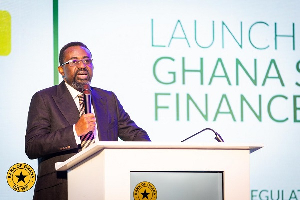
 Governor of the Bank of Ghana, Dr Johnson Pandit Asiama
The Governor of the Bank of Ghana, Dr Johnson Pandit Asiama, has launched a Sustainable Finance Roadmap aimed at integrating environmental, social, and governance (ESG) principles into the country’s financial system to strengthen resilience, improve risk management, and attract long-term investment.
Speaking at the Kempinski Gold Coast Hotel in Accra on Tuesday, June 30, 2026, Dr Asiama said sustainable finance has become central to global financial stability and investment flows, stressing that Ghana must adapt to emerging climate and economic risks.
“Sustainable finance is increasingly central to financial stability, to long-term investment, and to economic resilience. It is reshaping where global capital flows and what investors expect of financial systems,” the Governor said.
Climate risks now a financial stability concern – BoG Governor
He noted that climate change is already affecting financial stability in Ghana, citing recent flooding incidents as evidence of how environmental risks are translating into financial losses.
“A changing climate now bears directly on financial stability, as recent flooding across Ghana reminds us. Such risks do not stay in the environment; they travel into the financial system through the value of assets, the cost of claims, and the security of lending,” he explained.
Dr Asiama emphasised that addressing these risks requires coordinated regulatory action across Ghana’s financial sector, which includes banking, insurance, pensions, and capital markets.
“Risks of this kind respect none of these boundaries, and a risk that moves across the whole system cannot be managed by any one institution acting alone,” he said.
The Governor explained that the new roadmap provides a unified framework to guide regulators in implementing sustainable finance policies, anchored on ESG integration, climate-related risk management, and financing sustainability.
He said the initiative builds on nearly a decade of reforms, including the introduction of the Sustainable Banking Principles in 2019, which were voluntarily adopted by Ghana’s commercial banks.
Dr Asiama also highlighted progress in compliance, noting that industry adherence has steadily increased to about 73 percent as of September 2025.
According to him, the roadmap will move Ghana from fragmented initiatives to a coordinated system that supports green investment and long-term economic growth.
“Financing Sustainability is about mobilising private and institutional capital, developing green and blended finance, and positioning Ghana as a regional hub for sustainable finance,” he said.
He added that Ghana’s financial system must evolve beyond managing risks to actively shaping investment flows that support national development.
“Our purpose as regulators has always been the safety and soundness of the financial system. But soundness in this era means more than absorbing today’s shocks,” he said.
Dr Asiama expressed optimism that successful implementation of the roadmap would position Ghana as a leading destination for sustainable finance in Africa, while strengthening financial stability and access to climate-related funding.
MA

Copyright © 1994 - 2026 GhanaWeb. All rights reserved.










