



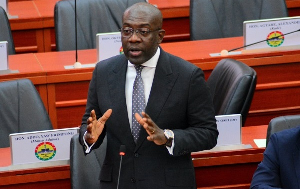
 Kojo Oppong Nkrumah is the Member of Parliament for Ofoase-Ayirebi
The Ranking Member on Parliament’s Economy and Development Committee and Member of Parliament for Ofoase-Ayirebi, Kojo Oppong Nkrumah, has criticised the Mahama administration’s handling of Ghana’s recurring flood disasters, arguing that no level of fiscal discipline can justify the loss of lives caused by delays in implementing critical flood-control projects.
Reacting to recent government explanations that expenditure controls were necessary to restore macroeconomic stability, Oppong Nkrumah insisted that protecting lives should never be sacrificed in the pursuit of fiscal consolidation.
Speaking on JoyNews, following the devastating floods that have claimed at least 37 lives and displaced thousands across parts of the country, the former Minister for Works and Housing described the government’s defence as “a very sad argument,” stressing that economic gains mean little to families who have lost loved ones.
“For the 37 people who have lost their lives, no amount of fiscal discipline or improved economic indicators will bring them back,” he stated.
His remarks come amid renewed public scrutiny of Ghana’s flood management strategy after torrential rains submerged several communities, destroyed homes and businesses, and once again exposed the country’s vulnerability to perennial flooding.
The disaster has reignited concerns over delays in executing major drainage and flood-control projects despite repeated warnings from experts and development partners about the need for sustained investment in resilient infrastructure.
Oppong Nkrumah maintained that while fiscal prudence remains important, government ought to distinguish between routine expenditure and investments that directly save lives.
He argued that many flood-control projects are financed through development partners rather than solely through the national budget, making it difficult to justify delays on the basis of expenditure controls.
According to him, government’s responsibility is often to provide the necessary administrative approvals and ensure timely release of funds to enable contractors to execute projects.
He said the consequences of delayed implementation extend far beyond fatalities, with thousands of Ghanaians losing homes, businesses and livelihoods because essential flood mitigation projects were not completed on schedule.
The legislator also dismissed claims that the Minority Caucus opposed the demolition of structures erected on waterways.
According to him, the Minority has consistently supported lawful efforts to remove illegal structures but rejects attempts to create what he described as false narratives that divert attention from the real issues affecting Ghana’s flood response.
He further criticised government officials for, in his view, shifting responsibility to institutions such as the Ghana Meteorological Agency and the National Disaster Management Organisation (NADMO), as well as ordinary citizens, instead of acknowledging policy shortcomings.
Oppong Nkrumah argued that concerns raised by the World Bank regarding delays in funding critical flood-control interventions should be addressed rather than ignored.
He urged government to confront the implementation challenges directly instead of assigning blame elsewhere.
Commenting on government’s announcement of a GH¢300 million allocation for flood-related interventions, the former minister welcomed the initiative, but cautioned that parliamentary approval alone would not guarantee successful implementation.
Drawing on his experience in government, he explained that many public projects fail not because Parliament withholds funding, but because approved funds are released too slowly to implementing agencies.
“I’ve been a minister,” he said. “Even when Parliament approves the money, if the speed of disbursement does not change, the funds will remain stuck and the intended projects will not be executed.”
He, therefore, backed the Minority Caucus’ call for Parliament to closely monitor both the release and utilisation of the newly approved funds to ensure they reach the intended projects without unnecessary delays.
Oppong Nkrumah also criticised government’s earlier decision to centralise funds from ministries, departments and agencies into the Single Treasury Account, arguing that the policy disrupted ongoing projects by depriving implementing institutions of resources that had already been allocated.
According to him, government later had to initiate processes to return funds to the same agencies, creating avoidable bureaucratic bottlenecks that slowed project execution.
The Ranking Member further accused government of politicising the World Bank-supported Greater Accra Resilient and Integrated Development (GARID) Programme.
He noted that while government officials had previously suggested the programme’s funds had been mismanaged or lost, they have now acknowledged that the facility remains fully funded, with ongoing discussions focused primarily on improving the speed of fund disbursement.
Oppong Nkrumah said the latest admission contradicts earlier political narratives and called on government to apologise for politicising what he described as a critical national development initiative.
He also defended former Vice President Dr Mahamudu Bawumia against accusations of politicising the recent floods.
According to him, Dr Bawumia has instead called for national unity and encouraged Ghanaians to support flood victims regardless of political affiliation.
He added that the former Vice President has fulfilled his pledge by donating relief items to affected communities while continuing to encourage individuals, organisations and institutions to contribute to relief efforts.
With forecasts indicating more rainfall in the coming weeks, Oppong Nkrumah urged government to move beyond political exchanges and focus on practical interventions to safeguard lives and property.

Copyright © 1994 - 2026 GhanaWeb. All rights reserved.










