



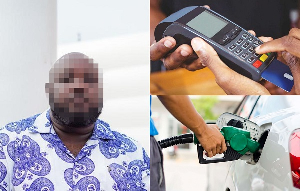
 The accused is alleged to have coordinated a pattern of transactions targeting fuel stations
A Nigerian businessman, Aderinsola Oluwanifemi Adeleye, is facing court over allegations of orchestrating a sophisticated Point of Sale (POS) fraud scheme that investigators say converted compromised foreign-issued debit cards into cash through fuel station transactions across Ghana.
The accused, who operates a cement block manufacturing business and resides at Oyarifa in Accra, is alleged to have coordinated a pattern of transactions targeting fuel stations, including Haatso Shell Filling Station and Osu Total Filling Station.
According to investigators, the scheme relied on Citibank debit cards issued in the United States, which were processed through POS terminals under the guise of legitimate fuel purchases. However, instead of fuel being dispensed, the transactions were allegedly structured to release cash immediately, effectively bypassing the retail payment system.
Nigerian suspect linked to INTERPOL, FBI fraud investigations arrested in Ghana
Ghana’s Cyber Security Authority said the operation depended on collusion at the point of sale, with fuel pump attendants allegedly facilitating transactions that appeared legitimate but were designed to extract cash value in real time.
Internal investigations by Shell Ghana led to the arrest of two attendants, who reportedly provided key details on how the system was exploited.
Investigators describe the method as a coordinated “cash-out loop,” in which mobile-linked credentials tied to Citibank Visa debit cards were used to initiate transactions that were approved at POS terminals and immediately converted into cash. The repeated nature of the visits made detection difficult, as the activity closely resembled routine fuel purchases.
The case first came to light on June 25, 2026, when the manager of Haatso Shell Filling Station reported suspicious POS activity following a complaint from Shell Headquarters, which had been alerted by Ecobank Ghana PLC over unauthorised transactions involving two Citibank customers through Visa International.
Investigators traced the transactions to POS terminals at both Haatso Shell and Osu Total Filling Station. Internal checks led to the arrest of two fuel pump attendants, who allegedly disclosed that the accused and an accomplice repeatedly visited the stations and used mobile-linked cards to initiate the transactions.
Police say the accused was later arrested at about 8:00 p.m. the same day at Haatso Shell Filling Station, where he was allegedly recognised by the attendants while attempting another transaction.
A search at the time of arrest led to the recovery of a Beretta pistol loaded with two rounds of 9mm live ammunition and a Citibank Visa debit card.
Further searches at the offices of AA Global Homes Construction Limited at Katamanso uncovered 15 rounds of live 9mm ammunition and one empty shell casing hidden in a drawer. The items were retained as exhibits.
Acting on intelligence, the Ghana Police Service, in collaboration with the Cyber Security Authority, executed a court-approved search at the accused’s residence at Oyarifa on June 27, 2026. Two mobile phones and other electronic devices believed to have been used in the alleged offences were retrieved for forensic analysis.
Investigators say the accused had previously been under surveillance for suspected cyber-enabled financial activity, with support from INTERPOL and the United States Federal Bureau of Investigation (FBI) contributing to the investigation.
During interrogation, the accused admitted using the Citibank debit card at the two fuel stations. He claimed it was sent to him by an individual in the United States identified as Gail Oneara, with an available balance of approximately US$10,000 for personal use, adding that he had withdrawn about US$8,000 before his arrest.
However, investigators maintain that evidence points to a wider cross-border fraud pipeline in which compromised foreign cards were funnelled into local POS systems and monetised through coordinated collusion at fuel stations.
Further investigations at Ecobank Ghana PLC confirmed that Citibank had reported unauthorised transactions involving the affected cards through Visa International.
Authorities allege that the accused, together with accomplices who remain at large, used fuel station POS systems to process fictitious fuel purchases. Once approved, the transactions were converted into cash instead of fuel, completing the cash-out cycle.
Investigators further allege that proceeds were used to acquire significant assets, including a four-bedroom storey building, a cement block manufacturing factory at Katamanso near Amrahia, a black Nissan ZNA pickup vehicle, and other properties suspected to be linked to proceeds of crime.
Forensic analysis of seized electronic devices is ongoing as authorities work to map the full structure of the alleged network, trace financial flows, and identify additional collaborators.
The case remains before the court.
With additional files from the Cyber Security Authority, Ghana
MA
Inside the AI revolution that could save lives on Ghana's roads

Copyright © 1994 - 2026 GhanaWeb. All rights reserved.










