



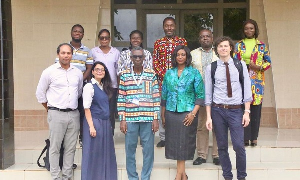
 The study was funded by the World Academy of Sciences (TWAS) and completed in late 2025
Research by the National Nuclear Research Institute (NNRI) of the Ghana Atomic Energy Commission (GAEC) has revealed increasing environmental pressures on some of Ghana’s most important wetlands.
The researchers warned that if current urbanisation trends continue, further wetland loss could occur by 2033 and 2043, potentially threatening the ecological integrity of the ecosystems and their ability to support sustainable water resource management.
The study, funded by the World Academy of Sciences (TWAS) and completed in late 2025, found that communities surrounding the Densu and Sakumo wetlands in Accra have experienced rapid urban expansion since 2013. Built-up areas around the Densu Wetland increased by 114%, while those around the Sakumo Wetland rose by 186%.
The research also detected elevated concentrations of heavy metals, including lead, arsenic and cadmium, in some locations, with levels exceeding recommended guideline values.
The findings were presented during a visit by a TWAS delegation, a programme unit of UNESCO, to the NNRI to assess the impact of the TWAS Seed Grant for New African Principal Investigators (SG-NAPI) programme, which supported the study.
The delegation was led by Payal Patel, Associate Programme Officer, and included Giovanni Ortolani, Public Information Officer, and Memoth Kanniakonil, Programme Assistant.
The visit aimed to evaluate the scientific, institutional and societal outcomes of the research project led by Dr. Cynthia Laar, Senior Research Scientist and Manager of the Water Resources Research Centre (WRRC) at NNRI.
Dr Laar was among the first cohort of African scientists selected under the highly competitive SG-NAPI programme, which supports promising early-career researchers across Sub-Saharan Africa.
Her project examined the long-term ecohydrological status and sustainability of the Densu and Sakumo wetlands, both of which are ecologically significant Ramsar sites in Ghana.
“Our findings indicate that if current trends continue, these wetlands will face further degradation in the coming decades,” Dr Laar said.
The scientists noted that wetlands play a crucial role in supporting biodiversity, regulating water systems, controlling floods and sustaining livelihoods in surrounding communities.
However, they warned that continued encroachment and pollution could undermine these ecological functions and increase environmental vulnerabilities.
According to Dr Laar, the TWAS grant enabled her team to acquire essential research equipment, train students, strengthen scientific collaborations and generate data to support environmental policy and management decisions.
“The support from TWAS provided the resources needed to undertake this important research and build scientific capacity within the institution,” she said.
Welcoming the delegation, the Director of NNRI, Professor Samuel Yao Ganyaglo, described the visit as an opportunity to demonstrate how international research support can strengthen scientific institutions and contribute to national development.
“We are excited to receive the TWAS team because this visit provides an opportunity for you to see first-hand the impact the grant has had, not only on Dr. Cynthia Laar’s research but also on the Commission as a whole,” he said.
Professor Ganyaglo noted that external research funding remains critical for African scientists working to address development challenges through evidence-based research.
“Support for scientific research in many African countries remains limited. Grants such as those provided by TWAS help scientists generate evidence-based solutions to national problems and contribute meaningfully to policy development and socioeconomic transformation,” he said.
Speaking on the rationale behind the SG-NAPI programme, Patel explained that the initiative was established to support talented African scientists returning home after completing doctoral studies abroad and to help them establish independent research careers.
“The purpose of this programme is to provide early-career scientists with the resources they need to establish themselves as independent researchers and build strong scientific careers in their home countries,” she said.
She noted that the programme remains highly competitive, attracting about 300 applications annually from across Sub-Saharan Africa, while only 25 to 28 grants are awarded each year.
“In the five years of the programme, we have received more than 1,500 applications and funded only 137 scientists. This demonstrates how competitive the programme is and highlights the significance of Dr Laar’s achievement,” she said.
Patel said the visit was intended not only to document scientific outputs but also to understand how research investments contribute to institutional development and broader societal benefits.
“Donors increasingly want to see how research funding benefits institutions and society as a whole,” she said. “It is important to understand the broader impact of these grants on the institutions that support the research and the communities that benefit from it.”
The TWAS delegation later toured key research facilities at NNRI, including the National Isotope Hydrology Laboratory and the Accelerator Research Centre, where they observed how nuclear and allied technologies are being applied to address environmental and developmental challenges in Ghana.

Copyright © 1994 - 2026 GhanaWeb. All rights reserved.










