



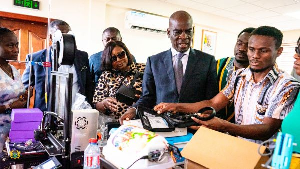
 Haruna Iddrisu is the Minister of Education
The Minister for Education, Haruna Iddrisu, has welcomed the introduction of innovative technology aimed at strengthening Science, Technology, Engineering and Mathematics (STEM) education, describing it as a practical solution that can simplify teaching and improve learning outcomes in schools.
The Minister made the remarks during a presentation by 3S Technology, in partnership with Coderina EdTech, on the STEM Education Mini Lab Project, an initiative designed to enhance practical STEM learning in schools across the country.
The project, known as the Adwenpa Project, brings together more than 40 STEM learning modules that align with the Ghana Education curriculum. The modules are housed in a self-contained Mini Lab and are designed to support practical STEM education for learners from Primary Four to Junior High School Form Three.
In the meeting, Haruna Iddrisu noted that the innovation has the potential to make the teaching and learning of STEM subjects easier and more engaging by enabling learners to experience scientific concepts in a practical way rather than relying solely on theory.
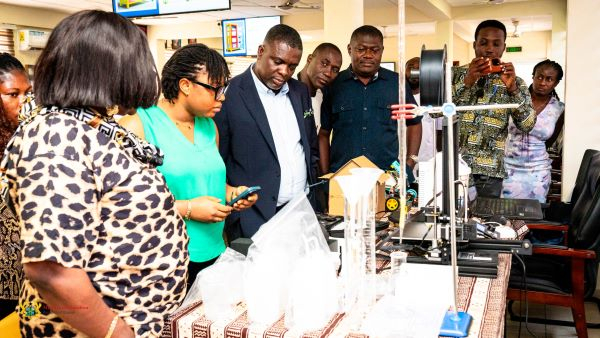
He therefore tasked the Director of STEM Education at the Ghana Education Service (GES), Madam Olivia Serwaa Opare, and the CEO of the Centre for Distance Learning and Open Schooling (CENDLOS), Dr Diyawu Mumin, to work with the developers of the project to compare the existing STEM learning resources with the proposed Mini Lab Project.
According to him, the assessment will help determine whether the current interventions require upgrading or enhancement before the Ministry considers the next steps.
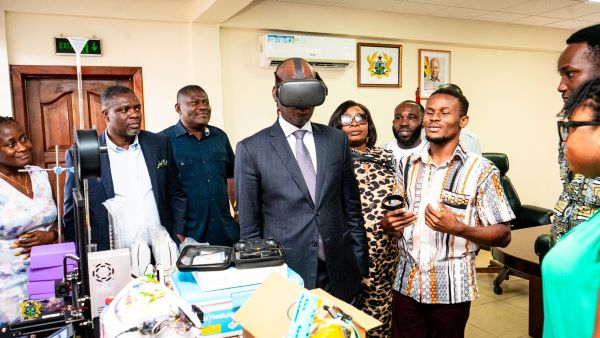
Earlier, the Director of STEM Education at GES, Olivia Serwaa Opare, explained that the Ministry has already invested significantly in STEM education through the provision of STEM Boxes and other laboratory equipment to schools nationwide. She said the Mini Lab Project has the potential to complement these interventions and expand access to quality practical STEM education.
She explained that one of the key features of the project is a Virtual Reality System (VRS), which uses a 3D headset to provide learners with an immersive learning experience. Through the technology, students can observe the behavior of the solar system, explore the human circulatory system and interact with several other scientific concepts that are often difficult to demonstrate in a traditional classroom.
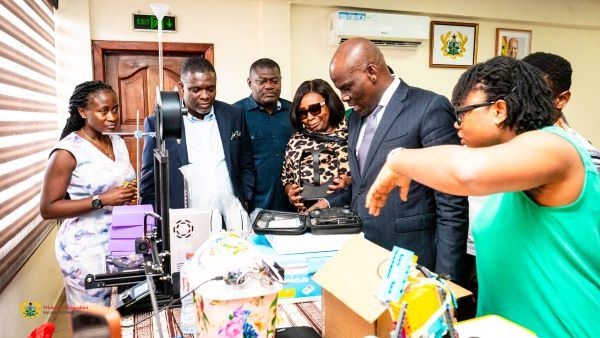
Opare noted that the Virtual Reality System is compact, secure and comes with preloaded educational content, making it easy to use and store in classrooms while providing learners with engaging practical experiences.
The presentation formed part of the ministry's efforts to explore innovative technologies that can support practical teaching and learning and equip learners with knowledge and skills needed for the future.

Copyright © 1994 - 2026 GhanaWeb. All rights reserved.










