



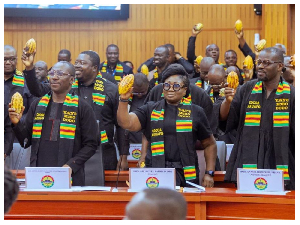
 Members of the Minority caucus in Parliament
The passage of the Tribunals Bill in Parliament on Thursday, July 16, 2026, was preceded by a walkout by the Minority Caucus.
The bill, which seeks to strengthen access to justice, protect the rights of citizens, promote due process, and improve the efficient administration of justice, particularly in matters requiring specialised or expeditious determination, faced strong opposition from the Minority over some of its provisions.
Here are five contentions raised by the Minority over the bill:
TUC opposes plan to re-establish Regional and District Tribunals
1. Unconstitutional parallel system;
One of the key concerns raised by the Minority, led by Alexander Kwamena Afenyo-Markin, was that the Tribunals Bill could create a parallel justice system that is not recognised under the 1992 Constitution.
“Our contention as a Minority is that this bill seeks to create a parallel system, an analogous system, unbeknown to the constitution, if we read all provisions of the constitution as a whole. It is true that mention is made of the tribunal system in our constitution, but context must be properly interpreted within the broader scope of articles 125, 126, and 127.
“We have a judicial system, district court, circuit court, high court, court of appeal, and the Supreme Court. If there are issues with the system, the way to go is to reform and to resource, equip, and retool. It is not to create a parallel system. We coordinate jurisdiction,” the caucus noted.
2. Lacking proper judicial composition;
The Minority also objected to Clause 4 of the bill, which provides for a three-member panel made up of one lawyer as chairperson and two non-lawyers as members.
According to the caucus, a body constituted in that manner should not be responsible for determining criminal matters.
“Now, if you look critically at the clause 4, which was a subject matter of this long debate, basically, you look at a new court system, I don't want to call it a court system, but a new adjudicated body where you say one person presiding as a chair must be a lawyer, but the other two must be non-lawyers, and they are going to preside on criminal matters,” the contended.
3. System could lead to people being pronounced guilty before trial;
The Minority further argued that the proposed arrangement could result in people being treated as guilty before their cases are determined by the courts.
“Now, what we see in this whole exercise is to create a system where people would be pronounced guilty even before their case is properly determined. No established procedure of ensuring fairness, and it is not only the Minority that is complaining. Today, Organized Labor has come out loudly to re-echo its position on this matter that we don't need a tribunal system in our country anymore,” the group stated.
4. Target individuals;
The Minority also argued that the tribunal system could be used to target individuals.
The Caucus referenced Ghana's experience during the PNDC era, alleging that tribunals at the time were used to target individuals and confiscate their assets. It maintained that the country's past experience with tribunals should discourage the creation of a similar system.
“Tribunal system, we know what happened in the PNDC era, where people were targeted, assets were seized, and those people who claimed they were tribunal members and rigged themselves, we know that record of the PNDC,” they said.
5. Bill undermines fair criminal trials;
The caucus also argued that the bill could undermine the fairness of criminal trials, insisting that judges must carefully assess the evidence before determining a person's guilt.
To support its position, the Minority cited Attorney General Dr Dominic Ayine's previous legal arguments in the Republic v. Tagor and Issa Abbas case, where he maintained that convictions must be based on evidence that proves all the essential elements of an offence.
Parliament passes Public Tribunal Bill despite Minority boycott
“We reminded Dr Ayine himself, the Attorney General, that when he was in practise as a private practitioner and he dealt with this case of the Republic v. Tagor and Issa Abbas, he argued forcefully that a judge sitting in a criminal trial must ensure that prosecution-led evidence of probated value proves all essential ingredients of the offence. That was his argument at the Court of Appeal, which was upheld that to deliver justice is not about ‘choboi’ or media headline screening. It's not about how the public perception about an individual is, because that can be misleading,” they further argued.
MAG/VPO
Mahama Ayariga speaks on Kwame Frimpong’s seat in Parliament

Copyright © 1994 - 2026 GhanaWeb. All rights reserved.










