



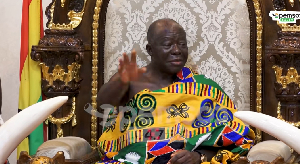
 Asantehene Otumfuo Osei Tutu II is the king of the Ashanti Kingdom
Otumfuo Osei Tutu II, the Asantehene, has noted that the chieftaincy institution as the custodian of land and culture, has proven resilient, adaptive and remains the first responder in community development, and the moral voice in seasons of national crisis.
He noted that long before the colonial culture was built, the institution of Chieftaincy stood as a principal holder of governance, justice, and social order among the people, noting that chieftaincy has endured because it commands the legitimacy that no statute alone can confer.
The King was speaking at a public lecture under the theme “The Supreme Court and the Institution of Chieftaincy, The Past, Present and Future”, at the Otumfuo Osei Tutu II Jubilee Hall, Manhyia Palace in Kumasi.
It formed part of activities to commemorate the 150th Anniversary of the Supreme Court under the theme; “Honouring the past, celebrating the present, and defining the future”.
The Asantehene noted that the two institutions, one ancient and the other modern, together have shaped the character of the nation's legal and cultural identity.
Otumfuo further indicated that the Supreme Court has acted not as a rival to Nananon (chiefs), but at its best, as a studying institutional partner, a forum of last resort, where the ancient system of justice is tested and reconciliation of the values of our greatest constitution including due process.
Otumfuo indicated that the fact that these two institutions, the parliaments and the courts, have chosen dialogue over confrontation, was never inevitable, noting it is the product of successive generations of chiefs, jurists, and politicians who understood that the strength of a republic lies not in the triumph of one system over the other, but in coexistence.
The Chief Justice, His Lordship Justice Paul Baffoe-Bonnie, for his part disclosed that as the Supreme Court celebrate this milestone, it gives it the chance not to only admire how far it has come, but also reminds them of how far the Supreme Court still have to go, noting that the greatest challenge of the courts must never be the one but must always be the next one.
According to him, the lecture is about a continuing conversation between two ancient institutions that have shaped the concept of our nation, expressing deep respect for the integral contribution of the institution of justice to the peace and stability of the nation.
Delivering the Keynote Address, Ivor Agyeman-Duah, Director of Manhyia Palace Museum disclosed the Supreme Court was in 1876, exactly 150 years ago, actively resistant to British ordinance, trade regulations, and land acquisition policies, noting that there was strong contestation regarding customary laws and traditions, whether in the northern parts of Gold Coast or earlier in the southern areas of Akan cities and coastal regions.
According to Agyeman-Duah the first 70 years of the Supreme Court was a glory and that it took about a half century for the chiefs and people in Asante and the northern part of Gold Coast to accept this.
He said it was after 1927, when the first Asante lawyer, Sir Edward Asafu-Adjaye, started practising in Kumasi, and supported the Asantehene’s preference in the affairs of the Asante Confederacy Council from 1935. He noted that as the Supreme Court celebrates its 150 years, Ghanaians must remember the ancestral convergences that directly or indirectly shaped this country.
The event was chaired by Ogyeahohoo Yaw Gyebi II, President of the National House of Chiefs and Paramount Chief of Sefwi Anhwiaso. The event was attended by Dr. Frank Amoakohene, Ashanti Regional Minister; Efua Ghartey, Esq., President of Ghana Bar Association; Kwame Owusu Sekyere (Esq) Ashanti Regional President of the Ghana Bar Association.

Copyright © 1994 - 2026 GhanaWeb. All rights reserved.










