



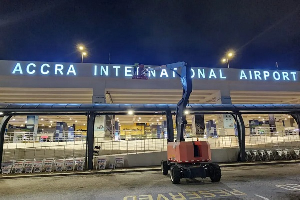
 File photo of Accra International Airport
Côte d'Ivoire shows the region what leadership looks like
The United Nations Development Programme has singled out Côte d'Ivoire as the only ECOWAS member state to have fully eliminated taxes on regional air transport a reform the UNDP describes as key to cutting ticket prices and drawing West African peoples closer together.
This did not happen by accident. It followed an ECOWAS Supplementary Act adopted in December 2024, which directed member states to scrap several categories of air transport taxes and cut passenger and security charges by 25 percent from January 2026.
Abidjan did not simply comply on paper. In April 2026, the Ivorian Council of Ministers passed three decrees revising passenger, safety, and security levies across domestic, regional, and international flights explicitly designed to make Air Côte d'Ivoire and the country's airports more competitive, and to position Abidjan as West Africa's leading aviation hub. Félix Houphouët-Boigny International Airport has seen its passenger traffic nearly triple since 2020, and Ivorian officials are betting that cheaper regional travel will accelerate that growth rather than shrink state revenue.
This is a country choosing to treat aviation as an investment rather than a cash register. It deserves commendation, and it deserves to be studied.
Ghana is moving in the opposite direction
While Côte d'Ivoire cuts, Ghana keeps adding. In February 2026, an $18 Advance Passenger Information/Passenger Name Record security charge took effect on return tickets. Then, on April 1, 2026, Ghana rolled out a new Airport Infrastructure Development Charge $100 on international return tickets and GH₵100 for domestic travellers layered on top of an already heavy fee structure.
Combined, passengers departing Accra now face roughly $173 one-way and $243 return in government-imposed charges alone, placing Ghana among the ten most expensive countries in the world for passenger charges and third highest in Africa, behind only Gabon and Sierra Leone.
ECOWAS itself has formally objected. In a letter from Commission President Omar Alieu Touray, the bloc noted "with concern" that Ghana's new charges run directly counter to the regional agreement every member state Ghana included signed up to.
Industry voices have echoed the warning: the Board of Airline Representatives Ghana has cautioned that these charges could undermine the country's aviation competitiveness at precisely the moment its neighbours are cutting costs to attract exactly the traffic Ghana is pricing out.
The irony is sharp. Ghana wants to be a regional aviation and logistics hub. Its neighbours are making that ambition harder to achieve by making themselves cheaper, faster, and more attractive to airlines and travellers alike.
The deeper problem: no comprehensive aviation policy
Commercial air travel is only one slice of the aviation sector, and treating it purely as a revenue stream reveals the absence of a broader strategic vision. Ghana does not yet have a comprehensive General aviation policy one that treats aviation holistically, covering commercial carriers, general and business aviation, cargo, MRO (maintenance, repair and overhaul), flight training, tourism, agricultural and medical and other aviation platforms as well as drone/UAS integration,
General aviation is frequently the quiet engine behind a country's aviation ecosystem: it trains the pilots and technicians commercial airlines eventually hire, it supports agriculture, health, and emergency response in ways scheduled airlines never will, it opens up domestic connectivity to underserved regions, and it seeds the private investment, MRO capacity, and aviation manufacturing that build long-term economic resilience. Countries that get this right building policy frameworks, tax incentives, and infrastructure around the entire aviation value chain rather than just ticket taxes end up with deeper, more diversified aviation economies.
Countries that only tax commercial tickets get short-term revenue and a shrinking passenger base.
Aviation as an SDG enabler, not just a toll booth
This matters beyond economics. Aviation is one of the few sectors that acts as a genuine cross-cutting enabler across the Sustainable Development Goals connecting to poverty reduction, health access, education, gender equality, decent work, industry and innovation, reduced inequalities, sustainable cities, climate action, and partnerships for the goals, among others.
Air connectivity moves emergency medical supplies, gets specialists to remote clinics, links farmers to markets, brings tourists and investment to landlocked or underserved regions, and gives young people pathways into high-value technical careers. A tax-heavy, commercial-only view of aviation squanders that leverage.
A comprehensive aviation policy treats the sector as infrastructure for national development the way roads, ports, and power grids are treated not as a luxury to be taxed at every opportunity.
The choice ahead
Côte d'Ivoire has shown that a government can choose to lower the cost of connecting its people to the region and the world, and be commended for it by international development institutions in the process. Ghana has shown, in the same year, what the opposite choice looks like and its own regional bloc has said so publicly.
If Ghana wants to be taken seriously as a regional aviation hub, the answer is not another passenger levy. It is a comprehensive Aviation and General aviation policy one that sees the full breadth of what aviation can deliver, aligns with ECOWAS commitments rather than contradicting them, and positions aviation as the strategic infrastructure it is: an engine of economic growth, social development, and the realisation of the Sustainable Development Goals.

Copyright © 1994 - 2026 GhanaWeb. All rights reserved.










