



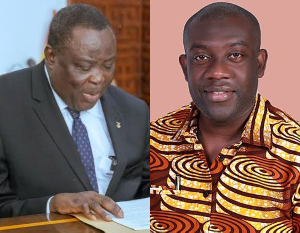
 Justice Pwamang (L) dismissed a motion that was filed by Oppong Nkrumah (R)
Member of Parliament for Ofoase Ayirebi, Kojo Oppong Nkrumah, has filed an application asking the Supreme Court to review its decision to dismiss his request to stop selected High Court judges from sitting during the legal vacation.
The application follows a ruling delivered by Justice Gabriel Scott Pwamang on Friday, August 21, 2026, which dismissed Oppong Nkrumah's interlocutory injunction application.
Supreme Court shuts down Oppong Nkrumah's bid to halt vacation trials
Oppong Nkrumah is challenging warrants issued by Chief Justice Paul Baffoe-Bonnie that allowed some High Court judges to hear criminal cases during the court's legal vacation.
He has argued in his substantive case that the decision raises constitutional issues, including concerns about equality before the law and the exercise of administrative discretion.
After his injunction application was dismissed, the lawmaker, through his lawyers, Davies and Davies, filed a motion on Monday, August 24, 2026, seeking a review of the decision.
According to the application, as shared by thelawplatform.com, Oppong Nkrumah is relying on eight grounds and wants a three-member panel of the Supreme Court to reverse the ruling and restrain High Court judges from conducting trials during the legal vacation until the main case is determined.
The report states that one of the main arguments raised in the review application is that the single judge went beyond the injunction application and made findings on issues that are still before the court in the substantive constitutional case.
Oppong Nkrumah pointed to several statements in the August 21 ruling, including the judge's conclusion that hearing cases during the legal vacation could not amount to inequality before the law and that the warrants did not limit the judges to hearing only selected cases.
The judge also held that it would be difficult to challenge the Chief Justice's exercise of discretion without evidence of ill will and noted that the arrangement was aimed at giving more criminal cases the opportunity to be heard quickly.
Oppong Nkrumah, however, maintains that these findings touch directly on the constitutional questions he has asked the Supreme Court to determine and should therefore not have been decided at the interlocutory stage.
Details of parts of his affidavit as shared by thelawplatform.online read, “23. In the course of his ruling, the learned judge made the following definite pronouncements and redeterminations on the substantive constitutional matters pending before the Supreme Court:
(i) At page 7 of Exhibit G :
" I am unable to see how priority of hearing of cases even during legal vacation can amount to inequality before the law."
"it is factually inaccurate to say that the warrants required the Judges to conduct trials in 'selected cases'."
"It is plain on the face of the warrants that the Judges have been given authorization to conduct hearings in all cases pending in their courts."
"It is differences in treatment on account of the grounds stated in clause (2) of article 17 that the Constitution is concerned with."
(ii) At pages 7 to 8 of Exhibit G:
"The plaintiff in his statement of case has not alleged that the Chief Justice's conduct in selecting the two Courts to give warrants to conduct hearings in the legal vacation was influenced by the gender, race, colour, ethnic origin, religion, creed or social or economic standing of the accused persons in those cases or their witnesses."
(iii) At page 8 of Exhibit G :
"It would be difficult to impeach the Chief Justice's exercise of discretion pursuant to articles 23 and 296(a) and (b) without any evidence of ill will."
Legal Vacation: Deputy AG, Oppong Nkrumah clash over Supreme Court ruling
(iv)At page 9 of Exhibit G :
"These statements plainly fail to take account of the existing standard practice where judges who sit during legal vacation take their leave when the rest of the courts resume work. As for the Court staff, their leave from work is not in any way affected by legal vacation sitting. For the lawyers, they are independent service providers in Court proceedings who are free to plan their leave at any time of the year."
"C.I.47 regulates civil cases and the subject matter of the plaintiff's complaint here are criminal trials."
(V) At page 10 of Exhibit G:
"In my understanding, the warrants issued by the Chief Justice that the plaintiff has complained about are an effort to afford opportunity for more criminal cases to be tried expeditiously."
MAG/VPO
#TrendingGH: 'Revisit the case' - Netizens react to controversial court ruling

Copyright © 1994 - 2026 GhanaWeb. All rights reserved.










