



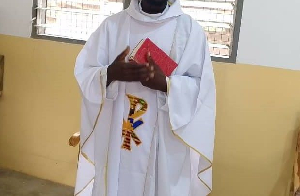
 A file photo of a Catholic Priest holding a bible during mass
The Catholic Diocese of Konongo-Mampong has disclosed that Rev Fr Samuel Adapore, whose whereabouts became a subject of concern following his indefinite suspension, has been located at the Police Training Centre in Koforidua in the Eastern Region.
The Diocese made the disclosure in a statement issued on August 27, 2026, in response to concerns and criticism over the priest’s suspension a divinis.
According to the statement, Fr Adapore “has been found at the Police Training Centre at Koforidua in the Eastern Region of Ghana.”
The Diocese explained that the priest had, “on his own and singular volition,” enrolled as a private individual in the training programme with the intention of joining the Ghana Police Service.
It did not disclose when Fr Adapore reported to the training centre or provide details on why he chose to pursue a career in the Police Service.
The clarification comes after questions emerged on social media over the Diocese’s decision to suspend the priest indefinitely.
Some critics questioned whether adequate steps had been taken to determine his location and welfare before the disciplinary measure was imposed.
Other concerns focused on the canonical grounds and procedures surrounding the suspension.
Catholic priest suspended after leaving parish without permission
References were made to Canon 533 and Canon 1717, as well as questions about whether Fr Adapore had been given an opportunity to defend himself.
The Diocese acknowledged that the concerns were legitimate but maintained that efforts to safeguard the priest’s welfare can exist alongside the Church’s responsibility to enforce ecclesiastical discipline.
“The Diocese does not object to questions about Fr Adapore’s welfare, whereabouts, and safety — indeed, it has every reason to share that concern,” the statement said.
However, it cautioned that a public announcement concerning disciplinary action does not necessarily provide a full account of every pastoral, administrative, canonical and personal measure taken in a particular case.
Diocese explains suspension
The Diocese said the Bishop has obligations not only towards the priest involved but also towards the parish and the broader Catholic community.
It explained that when a priest leaves his assigned parish without permission and subsequently becomes unreachable, the Bishop remains responsible for ensuring that the parish continues to receive pastoral care.
“If a pastor leaves his parish, removes his belongings, stops communicating, and does not return, the Bishop cannot simply set the matter aside indefinitely because his location is uncertain,” the Diocese stated.
It further rejected the notion that disciplinary proceedings against a priest automatically indicate that the Church has disregarded his welfare.
According to the Diocese, it is possible to establish the whereabouts and wellbeing of a priest while simultaneously addressing conduct that may constitute a breach of ecclesiastical discipline.
On Canon 533 §1, which requires a pastor to reside in his parish, the Diocese acknowledged the provision but said it should be interpreted alongside the wider canonical framework and the circumstances of the case.
“The full canonical framework must be considered rather than isolating a single canon,” it said.
The Diocese also noted that the specific grounds and procedures applicable to a disciplinary decree are determined by the facts and circumstances of each case.
It cautioned, therefore, against determining that the suspension was unlawful merely because the public statement did not outline every stage of the canonical process.
Diocese responds to investigation concerns
The Diocese also addressed the invocation of Canon 1717, which deals with investigations into information concerning a possible offence.
It explained that conducting an investigation does not necessarily prevent church authorities from taking steps they consider necessary to ensure the continued administration of the Church.
“If a priest is absent and cannot be reached, the Bishop cannot leave a parish without pastoral leadership indefinitely while waiting for every detail to become clear,” the statement said.
The Diocese said it must therefore strike a balance between determining the circumstances surrounding a priest’s absence and ensuring that the spiritual needs of parishioners continue to be met.
Regarding concerns about Fr Adapore’s right to defend himself, the Diocese maintained that canonical justice requires due process and that a priest facing allegations must be afforded the rights guaranteed under Canon Law.
At the same time, it argued that the inability to establish contact with an individual cannot indefinitely prevent the Church from carrying out its administrative and pastoral responsibilities.
The Diocese said determining whether the appropriate procedures were followed, whether efforts were made to contact Fr. Adapore and whether he was properly summoned would require a review of the actual canonical records.
It stressed that those matters cannot be definitively determined from the contents of a brief public statement.
The development follows the Diocese’s announcement days earlier that Fr Adapore had been suspended a divinis indefinitely, effective August 24, 2026.
The suspension was linked to what the Diocese described as serious acts, including his decision to leave the Diocese and discontinue his pastoral duties without legitimate authorisation.
Zanetor Agyeman-Rawlings to step down from Pan African Parliamentary role
AK/AM

Copyright © 1994 - 2026 GhanaWeb. All rights reserved.










