



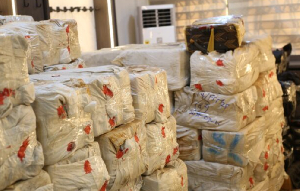
 File photo of narcotic substances
Ghana’s ports are facing renewed scrutiny following a series of major international drug seizures linked to shipments from the country, raising questions about the effectiveness of cargo screening and the possible involvement of officials or private actors in the narcotics trade.
The latest seizures include nearly 3.9 metric tonnes of cocaine intercepted in France and about $208 million worth of methamphetamine seized in Australia.
The French seizure comes only months after Australian authorities intercepted about 320 kilograms of methamphetamine concealed in bags of charcoal in a shipment from Ghana.
Former Director-General of the Ghana Ports and Harbours Authority (GPHA), Richard Amamoo, has explained how export containers are processed at Ghana’s ports and which agencies are responsible for checking their contents before they leave the country.
According to him, understanding the security arrangements at Ghana’s ports requires first establishing where the containers come from and where their contents are loaded.
Speaking on Joy News on September 13, 2026, he said containers leaving the ports generally fall into three categories: cargo originating from Ghana, transit cargo from neighbouring countries and transshipment cargo.
“The first is direct cargo from within Ghana that is leaving the ports outside,” he explained.
Transit cargo, he said, comes from neighbouring countries, including Mali, Burkina Faso, Ivory Coast, Togo and Benin.
He also explained that transshipment cargo consists of containers that arrive in Ghana after travelling on another vessel and are subsequently transferred onto another vessel.
“All these constitute containers that are leaving the port,” he said.
Where are export containers loaded?
Amamoo said an important change in port operations over the years is that containers carrying export goods are no longer loaded inside the port.
He explained that exporters and their agents load the containers before they arrive at the port, after which the containers are expected to be sealed and accompanied by the relevant documentation.
“The period when cargo used to be loaded into containers in our ports is long gone several years ago.
“In other words, containers arrive at the port already loaded and supposed to be sealed.”
He said the GPHA receives the container at the gate together with documentation indicating what it is carrying, its destination and the shipping line involved.
“What the port does is to receive the container at the gate already loaded with all the requisite documentation, stating what is supposed to be inside, where the container is going, the shipping line, and all of that information,” he explained.
Who checks the contents?
According to Amamoo, it is not primarily the responsibility of the GPHA to determine whether the actual contents of a sealed container correspond with its declaration.
He said that responsibility falls on the Ghana Revenue Authority’s Customs Division and other relevant regulatory agencies.
“That is the province of Customs and all the other agencies, EPA, narcotics, pharmacy, food and drugs authority, what have you,” he said.
He said authorities must establish where the container was loaded and who was responsible for loading it.
“Where was the container loaded and by whom? That is the beginning,” he said.
Amamoo explained that the information provided by the shipping line and forwarding agent should enable the relevant authorities to trace the origin of the cargo and establish the parties involved.
“Every shipping line, the container has to state exactly what is inside the container, who the shipper is, what is inside,” he said.
Why containers are not routinely opened
Amamoo said containers are not routinely opened at the port for physical inspection.
He explained that a container would normally only be opened if authorities have information or suspicion that something may be wrong.
He argued that physically opening every container would not be practical given the volume of cargo handled by the country’s ports.
“The container is not open at the port for physical examination. Remember, we are dealing with millions of containers, thousands of containers running around or coming into the port from various vessels.
“You cannot attempt to say that you're going to open the container inside the port and examine what is inside before I tell you there'll be total chaos in the port,” he noted.
He said cargo is expected to undergo the necessary loading and inspection procedures at approved locations before the sealed container reaches the port.
Amamoo added that Customs-approved shipping and forwarding agents are involved in the process and that inspection is expected to take place when cargo is consolidated.
What happens when there is suspicion?
The former GPHA boss said Customs is the key agency that can authorise the opening and physical examination of a container when there is suspicion about its contents.
He explained that the GPHA itself does not have the authority to independently open a sealed container.
According to him, once Customs clears the container, the GPHA’s role is largely to handle and move it within the port until it is loaded onto the vessel.
“As far as the Port Authority is concerned, it's the documentation. The Authority doesn't go in to strip the container to find out what is inside, unless there is a problem,” he said.
If information is received that a container may contain prohibited goods such as narcotics, he said the Port Authority must refer the matter to Customs.
From Australia to France: Major international drug busts linked to Ghana in recent times
“They will have to call Customs, and it's for Customs to either open and do whatever inspection they want to do, or the narcotics control board, or whatever,” he explained.
He further said the Narcotics Control Commission (NACOC) does not independently open containers at the port without going through the appropriate process.
“NACOC cannot just come in, you know, to say we want to open this container to see what's in there,” he said.
What about the port scanner?
Amamoo also questioned the assumption that export containers necessarily pass through a scanner at the port.
Based on his knowledge during his tenure, he said the scanner available at the time was primarily used for imports and not necessarily export cargo.
“To the best of my knowledge, that scanner is towards imports, as we see it now, and not necessarily exports of cargo, unless something is new that I don't know about,” he said.
He distinguished between containerised exports and certain goods, such as perishables, which can be brought into an export shed at the port before being loaded onto vessels.
But for large-scale containerised exports, he said the cargo is already inside the container before it arrives at the port.
“When we talk about containerized cargo, containerized cargo, that is huge,” he said.
He maintained that there is no process at the port where large volumes of containerised cargo are routinely unpacked, inspected and repacked before being loaded onto vessels.
JKB/MA
Stan Dogbe Orders Kpeshie Lagoon Restoration After Demolition of Illegal Structures

Copyright © 1994 - 2026 GhanaWeb. All rights reserved.










