



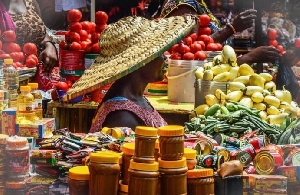
 A file photo of market in Accra
Ghana’s economy continues to stabilise, with inflation falling sharply from the levels recorded during the recent economic crisis.
However, for many consumers in Accra, the cost of everyday goods and household essentials remains a major concern, with GH¢1,000 no longer enough to cover several basic purchases.
The latest figures from the Ghana Statistical Service show that Ghana’s annual inflation stood at 5.0% in August 2026.
While the lower inflation rate means prices are increasing at a much slower pace than before, it does not mean that prices have returned to the levels seen before the economic crisis.
For consumers, this distinction is important. A lower inflation rate means the rate of price increases has slowed, not that goods have become cheaper.
GhanaWeb Business looks at 10 basic items and household needs that can cost more than GH¢1,000 in Accra, highlighting how far the amount can go for consumers today.
1. 50kg bag of premium imported rice – GH¢1,445 to GH¢1,511
Rice remains a major household staple, but a 50kg bag of premium imported rice can now cost more than GH¢1,000.
For example, a January 2026 wholesale price list showed a 50kg bag of Lele rice at GH¢1,511.10, while the bulk price was GH¢1,445.40.
This means GH¢1,000 would not be enough to buy a full 50kg bag at those prices.
10 most expensive neighbourhoods to live in Accra
2. Small tabletop refrigerator – above GH¢1,000
A small tabletop refrigerator can also take a significant chunk of a household budget.
Prices in electronic shops can exceed GH¢1,000, meaning consumers looking to purchase even a compact refrigerator may have to spend beyond the amount.
3. King-size mattress – GH¢4,990 to GH¢5,540
For consumers looking to replace a mattress, GH¢1,000 may fall well short of the amount required for a king-size option.
A king-size mattress can cost between GH¢4,990 and GH¢5,540, depending on the brand, features and point of purchase.
At the lower end of that range, the price is nearly five times GH¢1,000.
4. Three-in-one sofa – GH¢1,400 to GH¢2,100
Furnishing a room can also quickly push spending beyond the GH¢1,000 mark.
A three-in-one sofa currently sells for around GH¢1,400 to GH¢2,100, depending on the design, material and seller.
This means a consumer with GH¢1,000 would still need additional funds to purchase even a basic sofa set within this price range.
5. 1.5HP air conditioner – several thousands of cedis
An air conditioner is another household item that is now well beyond the GH¢1,000 threshold.
A standard 1.5HP split-unit air conditioner can cost several thousands of cedis, excluding installation.
For households looking to improve indoor comfort, the purchase therefore requires considerably more than GH¢1,000.
6. Four-burner gas cooker – above GH¢1,000
A four-burner gas cooker with an oven compartment can also exceed GH¢1,000.
Depending on the brand, design and features, consumers may have to spend considerably more than the amount to equip their kitchen with a new cooker.
7. 12-yard premium wax print – above GH¢1,000
Clothing and fabrics can also push household spending beyond the threshold.
A full 12-yard piece of premium wax print from recognised brands such as GTP or Woodin can cost more than GH¢1,000, depending on the design, quality and collection.
For consumers purchasing fabric for major occasions, GH¢1,000 may therefore not be enough for a full piece of premium wax print.
8. Household water tank – GH¢1,200 to GH¢1,500
Water storage has become an important household need, particularly for homes that experience interruptions in water supply.
A small-sized household water tank can cost around GH¢1,200 to GH¢1,500, depending on the brand, size and quality.
This puts even a basic water-storage solution above the GH¢1,000 mark.
9. Large gas cylinder – GH¢2,000 to GH¢2,500
The cost of acquiring a large gas cylinder can also exceed GH¢1,000.
A new cylinder can cost around GH¢2,000 to GH¢2,500, particularly when the cost of purchasing and filling it is considered.
For households switching to or expanding their use of LPG, the initial cost can therefore be substantial.
10. Monthly grocery restock – above GH¢1,000
For many households, GH¢1,000 can also be exhausted during a single grocery-shopping trip.
A monthly restock covering items such as cooking oil, flour, canned foods, detergents, toiletries and other household essentials can easily exceed GH¢1,000 for a small family, depending on the quantities and brands purchased.
What GH¢1,000 tells us about inflation
The examples highlight the important difference between falling inflation and falling prices.
Ghana’s lower inflation rate means the pace at which prices are rising has slowed. It does not mean that the prices consumers currently face have returned to the levels recorded before the recent economic crisis.
For many residents in Accra, GH¢1,000 is increasingly becoming a starting point rather than a comfortable shopping budget.
The amount can be exhausted on a single household purchase, leaving consumers with little or nothing to spend on other needs.
ANAS/MA
AI Adoption: Businesses must solve real problems, not chase trends – Carlos Amoako

Copyright © 1994 - 2026 GhanaWeb. All rights reserved.










