



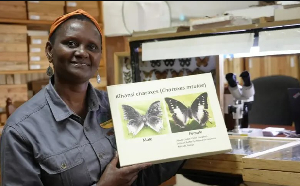
 Dr Mtui has contributed to research on Tanzania’s butterfly species
A Tanzanian scientist who went into a forest searching for frogs ended up discovering a butterfly that would later be named after her.
Dr Devolent Mtui was conducting research in Kihansi Gorge, part of Tanzania’s Eastern Arc Mountains, when she encountered a butterfly that had not previously been documented by science.
The discovery began a lengthy identification process that lasted more than a decade, from 2005 to 2017.
The butterfly was eventually described as a new species, Charaxes mtuiae, with the species name honouring Dr Mtui.
Dr Mtui collected and identified more than 200 butterfly species in Kihansi Gorge, contributing to knowledge of the rich biodiversity of the Eastern Arc forests.
But the butterfly named after her was particularly significant.
Its caterpillars depend on a specific plant, meaning efforts to protect the butterfly also require attention to the habitat and plant species on which it relies.
The discovery has since become part of Mtui’s wider conservation work and efforts to encourage interest in African biodiversity.
Through the Tanzania Wildlife Research Institute (TAWIRI) and the National Environment Management Council, she received funding from the Global Environment Facility (GEF) to assess the status and distribution of C. mtuiae
Dr Mtui holds a bachelor’s degree from the University of Dar es Salaam, a master’s degree in Conservation Biology from the University of the Witwatersrand in Johannesburg, South Africa, and a PhD in Natural Resources and Environmental Management from the University of Hawaiʻi at Mānoa.
A Ghanaian scientist’s breakthrough research on fluorescent molecular probes
She also has expertise in remote sensing and geographic information systems (GIS) and has published six scientific papers in peer-reviewed journals.
Her work comes against the backdrop of a shortage of insect taxonomists in Tanzania, with many local experts retired or approaching retirement and others based at foreign universities and museums.
The shortage means insects collected during research projects sometimes have to be identified by experts outside the country, limiting local capacity to document Tanzania’s invertebrate biodiversity.
In a recent feature on BBC Africa, she reflected on the journey that began with her search for frogs and the discovery of the butterfly that bears her name.
"When I started here, everyone used to say that I was crazy and I was busily searching for insects. My duties were limited. I was searching for frogs, So, I thought of what else I could do in the area.
"So, I decided to look for butterflies, just to observe them. It was a leisure thing," she narrated.
Her work is now contributing not only to the documentation and conservation of Tanzania’s butterfly species but also to efforts to build a new generation of African scientists working to understand and protect the continent’s biodiversity.
Watch the video below:
She went looking for frogs and accidentally found a butterfly that would later be named after her. 🦋
Here is Tanzania's Dr Devolent Mtui’s story and how she is inspiring a new generation to champion African biodiversity.🎬 @BrianOsweta
— BBC News Africa (@BBCAfrica) September 25, 2026
🎥 Yusuph_mazimu & Bosha Nyanje pic.twitter.com/LSGcTCeepv

Copyright © 1994 - 2026 GhanaWeb. All rights reserved.










