



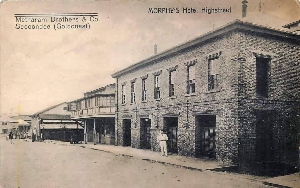
 File photo of Ancient Sekondi Township
Sekondi and Takoradi, two historic towns in Ghana’s Western Region, are widely known today as the twin city of Sekondi-Takoradi.
However, the towns developed as separate settlements, with their own identities and histories, before economic growth and urban expansion brought them together.
According to historical accounts shared by Fante Voice Studios on social media and cited by GhanaWeb on October 10, 2026, Sekondi was the region’s original administrative centre, housing key government offices and institutions.
Takoradi, on the other hand, experienced significant economic growth following the construction of its seaport, which transformed it into a major centre of commercial activity.
The development of the Takoradi Port attracted businesses, workers and other economic activities to the area, contributing to Takoradi’s growing prominence. As the two towns expanded towards each other, their close proximity and interconnected economic activities increasingly led people to refer to them collectively as Sekondi-Takoradi, or the Twin City.
Despite the shared name, Sekondi and Takoradi retain distinct historical identities.
Sekondi’s Fante heritage
Beyond its administrative significance, Sekondi has a rich cultural history closely associated with the Fante people.
Historical photographs of the town offer glimpses into its past, documenting Fante women, girls, artisans and community groups.
The images provide a visual record of the people, cultural practices and traditional architecture that helped shape the town’s identity.
One of the historical images reportedly depicts Fante girls in Sekondi, while another features Morphy’s Hotel, described as an example of Fante architecture built by Fante people.
Other photographs capture Fante women and artisans, alongside a group of Fante people in the Gold Coast era, with Sekondi identified as the location.
The collection also includes a reference to a woman from Sekondi who is described as the first Ghanaian beauty queen during the Gold Coast period.
Together, these historical records highlight Sekondi’s cultural and social significance before the modern development of the twin city.
Understanding the historical spellings of Fante
The photographs and accompanying descriptions also draw attention to the different spellings historically used for the Fante people.
Terms such as “Fanti”, “Fantyn” and “Fantee” appear in older historical records and documents from the Gold Coast era.
The more commonly used modern English spelling is “Fante”, while “Fantse” is the traditional form used in the language itself.
These variations reflect changes in the ways the people and their language have been represented in historical documents over time.
Two towns, distinct histories, one twin city
Today, Sekondi-Takoradi stands as an important urban centre in Ghana, combining the administrative and historical legacy of Sekondi with the commercial and maritime significance of Takoradi.
The story of the twin city illustrates how economic development, particularly the establishment of a major port, can reshape the growth and identity of neighbouring settlements.
Although the two towns are now commonly identified as one urban area, their individual histories remain an important part of Ghana’s Western Region cultural heritage.
https://web.facebook.com/share/p/1FAGtAAJ9t/

Copyright © 1994 - 2026 GhanaWeb. All rights reserved.










