


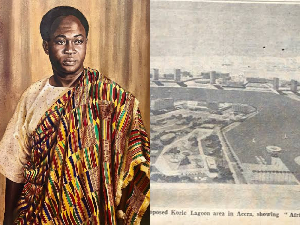
 The project was designed to turn the lagoon area into a major residential, cultural destination
Ghana’s first President, Dr Kwame Nkrumah, had ambitious plans to transform Accra’s Korle Lagoon into a modern waterfront district featuring high-rise apartments, hotels, cultural centres, recreational facilities and a 120-metre tower symbolising African unity.
The proposed Korle Lagoon Development Project, presented in 1964, was estimated to cost about £2.8 million and formed part of the broader Accra-Tema development programme during the Nkrumah administration.
According to a report published by the Daily Graphic on June 20, 1964, the project was designed to turn the lagoon area into a major residential, cultural, tourism and recreational destination.
One of the most striking features of the proposed development was the African Unity Light Tower, a 120-metre structure expected to become a major landmark along Accra’s coastline.
The tower was intended to symbolise African emancipation and unity, with plans for a restaurant and viewing platform near its top, as well as, exhibition space at ground level.
Beyond the tower, the development plan included high-rise residential blocks expected to accommodate about 15,000 people, a major hotel, a cultural centre, a museum, an African art gallery and an amphitheatre.
Other proposed facilities included restaurants, cinemas, an amusement centre, sports facilities and a marina, making the project an ambitious attempt to combine modern housing, entertainment and tourism in one waterfront district.
The project also reflected Ghana’s international architectural partnerships during the early 1960s.
Here's the plan Nkrumah had that could transform Ghana today
The country worked with architects and engineers from the Soviet Union and other Eastern European countries on major urban development proposals for Accra and Tema.
Research into Ghanaian architecture during the period indicates that Soviet specialists prepared studies for large-scale residential developments, while other foreign architectural teams also produced proposals for Accra’s waterfront.
However, the Korle Lagoon of the 1960s was not without environmental challenges. Although the lagoon had historically supported fishing, recreation and other economic activities, pollution and sanitation concerns were already emerging during the period.
The government took control of the lagoon in 1961, and it was dredged between 1961 and 1963 as part of efforts to address flooding and reshape the surrounding area.
Despite the ambitious plans, the proposed 1964 waterfront development was never realised in the form originally envisioned.
Today, the contrast between Nkrumah’s vision and the lagoon’s present condition is striking. Korle Lagoon remains an important drainage outlet for Accra but has suffered decades of pollution, siltation and environmental degradation.
Although restoration efforts have been undertaken at different times, the environmental challenges remain significant.
The unbuilt project nevertheless offers a glimpse into Nkrumah’s ambition to transform Ghana’s capital into a modern African city and remains one of the remarkable urban development visions of the post-independence era.
MRA/VPO
'Not a single complaint' – Ablakwa challenges claims of SA evacuation payment shortfalls

Copyright © 1994 - 2026 GhanaWeb. All rights reserved.










