


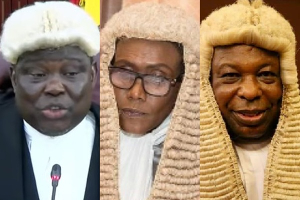
 The three most senior Supreme Court Justices
Chief Justice Paul Baffoe-Bonnie is expected to retire in the coming weeks, having attained the compulsory retirement age of 70 for judges. His impending retirement is set to trigger another succession process at the Supreme Court, with attention turning to the most senior justices of the court as potential candidates to replace him.
The convention has been that the most senior Supreme Court justices who are not close to retirement are appointed Chief Justice when the position becomes vacant, although there have been rare instances where a more senior justice was overlooked in favour of another candidate.
While seniority has traditionally played a significant role in the selection process, the 1992 Constitution gives the President the authority to nominate a Chief Justice, subject to consultation with the Council of State and approval by Parliament.
If President John Dramani Mahama opts to go with the tradition of appointing the most senior judge as the Chief Justice, as he did with the appointment of Baffoe-Bonnie, the lot might fall on these three justices: Justice Gabriel Scott Pwamang, Justice Avril Lovelace-Johnson and Justice Issifu Omoro Tanko Amadu.
Mahama in Chief Justice dilemma as Baffoe-Bonnie retires in weeks
Below are brief profiles of the three justices.
1. Justice Gabriel Scott Pwamang
Justice Gabriel Scott Pwamang is the longest-serving member of the Supreme Court among the three justices, having joined the apex court in June 2015 following his nomination by President John Dramani Mahama, during his first term.
Justice Pwamang, per the laws of the country, would assum the Acting Chief Justice role the day Baffoe-Bonnie retires.
Before his appointment to the Supreme Court, Justice Pwamang spent approximately 26 years in private legal practice, where he developed expertise in land and natural resources law, human rights and criminal justice. He was the managing partner of Pwamang & Associates and also served as board chairman of the Centre for Public Interest Law (CEPIL), a civil society organisation involved in public-interest litigation and legal issues affecting communities.

His professional background also extends into constitutional governance and politics. Justice Pwamang served as deputy general secretary and subsequently general secretary of the People's National Convention (PNC) between 1998 and 2007. In 2012, he contested the Navrongo Central parliamentary seat on the party's ticket.
He was also a member of the Constitution Review Commission established in 2010 to review the 1992 Constitution and make recommendations for constitutional reform. His work on the commission included participation in the drafting of proposed amendment bills.
Justice Pwamang's more than a decade of experience on the Supreme Court, combined with his background in private legal practice, constitutional reform and public-interest litigation, places him among the most experienced members of the court.
2. Justice Avril Lovelace-Johnson
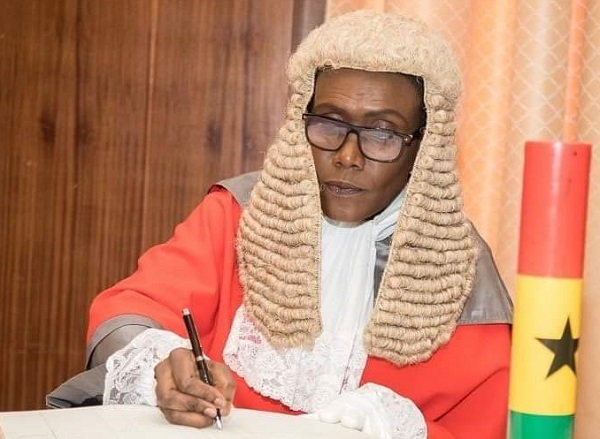
Justice Avril Lovelace-Johnson is the second-most senior justice on the Supreme Court, having been appointed to the apex court in December 2019 by former President Nana Addo Dankwa Akufo-Addo.
Unlike Justice Pwamang, who joined the Supreme Court after an extensive career in private legal practice, Justice Lovelace-Johnson rose through the ranks of the Judiciary, accumulating decades of experience across the various levels of the court system.
She began her judicial career as a District Magistrate before becoming a Circuit Court judge in June 1994. She was elevated to the High Court in June 2002, serving in the Accra and Tema divisions, and was appointed a Justice of the Court of Appeal in October 2012.
Her judicial experience also includes an international assignment in The Gambia, where she served as a High Court judge from December 2005 to 2009 under an arrangement involving the Commonwealth Secretariat. During that period, she also served as an additional Justice of the Court of Appeal.
Beyond her judicial work, Justice Lovelace-Johnson served as Director of the Public Complaints and Courts Inspectorate Unit of the Judicial Service from 2014 to 2016. She was also Vice-President of the Association of Magistrates and Judges of Ghana.
Her progression through the magistracy, Circuit Court, High Court and Court of Appeal gives her extensive experience in the administration of justice at different levels.
3. Justice Issifu Omoro Tanko Amadu

Justice Issifu Omoro Tanko Amadu is the third-most senior justice on the Supreme Court, having joined the apex court in 2020 following his nomination by former President Nana Akufo-Addo.
Born on September 11, 1957, in Dodowa in the Greater Accra Region, Justice Amadu received his early education in the town before attending Ghanata Senior High School and Ghana Secondary School in Koforidua.
He studied law at the University of Ghana and proceeded to the Ghana School of Law for his professional legal training. His career also took him to Nigeria, where he practised law for approximately 19 years, working with law firms including A.C. Mathews & Co. and Alao Aka Bashorun & Co.
He later established his own legal practice and served as principal of Amadu & Co. before becoming a judge.
Justice Amadu was appointed to the High Court in 2008 and elevated to the Court of Appeal in 2012. He served on the appellate court until his appointment to the Supreme Court in 2020.
His career combines extensive private legal practice, including international experience, with service at the High Court and Court of Appeal. Justice Amadu is also recognised as the first Muslim to serve on Ghana's Supreme Court.
BAI
Guns and Drugs: Dr Adam Bonaa Warns of Growing Security Threat to Ghana

Copyright © 1994 - 2026 GhanaWeb. All rights reserved.










