


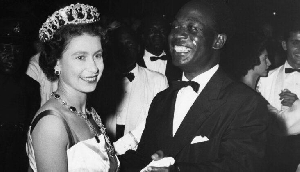
 A photo of Dr Kwame Nkrumah and Queen Elizabeth II on the dance floor
On November 9, 1961, Queen Elizabeth II arrived in Ghana despite security fears following bomb attacks in Accra, beginning a historic 12-day visit that would produce one of the most memorable diplomatic moments in Ghana’s history: a dance with President Kwame Nkrumah.
More than six decades later, the image of Queen Elizabeth II dancing with Ghana’s first President, Dr Kwame Nkrumah, remains one of the most remarkable moments in the history of Ghana-Britain relations.
But behind the photographs, music and diplomatic smiles was a visit that almost did not happen.
On November 9, 1961, the British monarch arrived in Accra with her husband, Prince Philip, Duke of Edinburgh, for her first official state visit to Ghana. The visit, which lasted until November 20, came at a politically sensitive time, with growing tensions surrounding Nkrumah's administration and serious concerns about the Queen's safety.
Just five days before her arrival, Accra had been rocked by two bomb explosions on November 4. One destroyed the feet of a life-size statue of Nkrumah outside Parliament House, while another damaged a storeroom near the Freedom and Justice Arch at Black Star Square, where the Queen was expected to attend a military parade.
The incidents triggered anxiety in Britain, with some politicians questioning whether the monarch should proceed with the trip. British Prime Minister Harold Macmillan and security officials faced pressure to reconsider the visit.
However, Elizabeth II was determined to honour her commitment to Ghana. In a remark reported by TIME magazine in November 1961, she reportedly told Macmillan: "I am not a film star. I am the head of the Commonwealth — and I am paid to face any risks that may be involved."
The British government eventually cleared the visit after assessing the security situation and receiving assurances from officials on the ground.
A visit loaded with political significance
The Queen's arrival was more than a ceremonial engagement. Ghana had gained independence from Britain on March 6, 1957, and become a republic on July 1, 1960, with Nkrumah serving as its first President.
Although Ghana had ended its constitutional ties to the British Crown, it remained a member of the Commonwealth, with Elizabeth II serving as its Head.
The visit therefore carried considerable diplomatic significance. It offered an opportunity for both countries to demonstrate that their relationship could survive the transition from colonial rule to an independent republic.
At a state dinner in Accra, Nkrumah delivered a memorable toast that captured the changing relationship between the two countries.
"The wind of change blowing through Africa has become a hurricane," he declared.
He added: "Whatever else is blown into the limbo of history, the personal regard and affection which we have for Your Majesty will remain unaffected."
The statement was particularly significant because Nkrumah had become increasingly critical of Britain's colonial legacy and was pursuing a more independent foreign policy.
In her response, Elizabeth II stressed that Commonwealth membership did not require countries to surrender their sovereignty or individuality. She described the organisation as a family of equals whose members could hold different political views without abandoning their association.
The dance that captured the world's attention
However, it was not the political speeches or diplomatic exchanges that would make the visit particularly unforgettable.
One of its most celebrated moments came when Elizabeth II took to the dance floor with Nkrumah.
The two leaders danced together to Ghanaian music during the state dinner, creating an extraordinary spectacle that attracted international attention.
For a former colonial ruler to share a dance with the President of a country that had only recently emerged from British colonial rule was a powerful image.
It represented a changing political relationship, with Ghana no longer a British colony but an independent nation engaging Britain as a Commonwealth partner.
The moment also offered a striking contrast to the political tensions surrounding the visit. Despite the security concerns and disagreements over Ghana's political direction, the Queen and Nkrumah appeared together in a display of warmth and diplomatic goodwill.
The dance subsequently became one of the defining images of Elizabeth II's relationship with Ghana.
Beyond Accra: The Queen's tour of Ghana
The 12-day visit also took the royal couple beyond the capital.
Elizabeth II and Prince Philip travelled to Kumasi, where they met traditional leaders and visited the Kumasi Sports Stadium, now known as the Baba Yara Sports Stadium.
During her stay in the Ashanti Regional capital, the Queen reportedly described Kumasi as the Garden City of West Africa, an expression associated with the city's rich vegetation and greenery.
The royal couple also visited Tamale, where they were treated to traditional Ghanaian music and dance performances.
Another significant aspect of the visit was its connection to Ghana's development ambitions, particularly the Volta River Project, which was central to Nkrumah's industrialisation agenda.
The visit helped Ghana secure the British government's support for financing the Volta Dam project, an important development in the country's efforts to expand electricity generation and industrial capacity.
Yet, the trip was not without its politically uncomfortable moments. The Queen also visited the young son of an imprisoned opposition politician, an engagement that reportedly displeased Nkrumah.
A diplomatic moment that outlived the visit
Elizabeth II's 1961 visit remains significant because it demonstrated how diplomacy could bridge political differences, even in the aftermath of colonialism.
For Ghana, the visit was an opportunity to assert its independence while maintaining an important international relationship. For Britain, it was a chance to preserve its Commonwealth connections with one of Africa's most influential newly independent nations.
The Queen returned to Ghana in November 1999, 38 years after her first visit, accompanied by Prince Philip. That second visit further reinforced the longstanding relationship between the two countries.
Elizabeth II died on September 8, 2022, but the photographs of her dancing with Nkrumah remain an enduring reminder of a remarkable chapter in Ghana's diplomatic history.
On November 9, 1961, the Queen arrived in a country facing political uncertainty and security concerns. She left behind memories of a visit in which high-level diplomacy, Ghanaian culture and an unexpected dance combined to create a moment that continues to fascinate generations.
EA

Copyright © 1994 - 2026 GhanaWeb. All rights reserved.










