



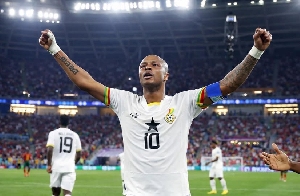
 Dede Ayew is a former captain of the Black Stars
The debate refuses to die down.
In homes, on radio, in press boxes and on social media timelines across Ghana, one question keeps resurfacing: should Andre Ayew go to the 2026 World Cup?
For some, the answer is simple. If you are not actively playing, you have no business representing Ghana on the biggest stage.
It is a school of thought that has grown louder in recent years, one that measures readiness by postcode rather than performance.
But football has never been that mechanical.
Andre Ayew’s story with the Black Stars did not begin yesterday. Long before the arguments about the Eredivisie or squad rejuvenation, he was the fearless teenager who captained Ghana’s Under-20 side to a historic triumph at the 2009 World Cup in Egypt.
'We are not going to joke at the World Cup' - Coach Nimley questions Andre's inclusion
A moment that permanently stitched his name into the country’s football fabric. From that day, he was no longer just Abedi Pele’s son. He became Andre Ayew.
He carried that leadership into three senior World Cups: 2010 in South Africa, 2014 in Brazil and 2022 in Qatar.
In 2022, he wore the captain’s armband. Not many players in Ghana’s history can point to that résumé, not even his dad.
And yet, football is cruel to sentiment.
Ayew was part of the squad that began Ghana’s recent World Cup qualification journey.
He was on the bench in the opening match against Madagascar in November 2023 under Chris Hughton. He featured in the second game, the 1-0 defeat away to Comoros.
Then came the managerial change. Hughton was dismissed, Otto Addo returned, and quietly, Ayew’s name began to disappear from team sheets.
Under Otto Addo’s second stint, he did not feature. Even during the 2025 AFCON qualifiers, he was not in the coach’s plans, despite being active in Ligue 1 with Le Havre at the time.
For many, that was the clearest signal that the chapter was closing.
Then came another twist. After leaving Le Havre at the end of the 2024/25 season, Ayew spent months without a club. Critics sharpened their arguments.
At 36, without a team, was this not the natural end?
But in January 2026, he resurfaced in the Eredivisie with NAC Breda. It was not Real Madrid.
It was not the Premier League. It was not one of the fashionable “Top Five.” And immediately, the critics returned: the league isn’t strong enough. The level isn’t high enough.
The pace won’t prepare him for the World Cup.
Yet here is where the debate becomes layered.
Is international football only for players in England, Spain, Germany, Italy and France? If that were true, several nations would have no teams.
World Cups have been shaped by players outside those elite leagues, men whose hunger outweighed their address.
The real question is not geography. It is impact.
At 36, Ayew is no longer the explosive winger of 2010. He is no longer the relentless runner of Brazil 2014.
But what he has gained is something Ghana often lacks when tournaments begin to slip away: emotional control, tournament experience and the stubborn refusal to shrink under pressure.
There is also the matter of history. If selected, Ayew would join a rare group of players worldwide to feature in four different World Cups.
That is not a sentimental milestone; it is a testament to longevity and relevance across generations.
But history alone cannot win matches.
Otto Addo must ask himself hard questions.
Is Ayew among the best attacking options available right now? Can he contribute on the pitch, not just in the dressing room?
Does his presence elevate the younger players or block their growth?
Because the World Cup is not a testimonial tour. It is unforgiving. Fitness, tempo and sharpness matter.
At the same time, Ghana’s World Cup campaigns have often swung on mentality. In 2010, belief carried the team to the brink of a semi-final.
In 2022, moments of inexperience cost crucial points. Sometimes, the margins are psychological.
Ayew’s supporters argue that his grit, that relentless drive that defined his prime, could be the intangible Ghana needs.
A late cameo to steady nerves. A decisive penalty.
A captain’s voice in a chaotic dressing room.
His critics counter that the Black Stars must evolve. That clinging to past heroes delays renewal. That the World Cup should reflect current form, not past glories.
And perhaps both sides are right in different ways.
This debate is not really about the Eredivisie. It is not even fully about age. It is about direction.
Is Ghana building purely for the future, or balancing transition with experience? Does legacy earn consideration, or does every cycle begin with a clean slate?
If Ayew proves at NAC Breda that he can still influence games consistently, not just appear, but impact, the argument for his inclusion strengthens.
If he struggles to command matches in the Dutch league, the decision becomes clearer.
For now, the conversation remains open.
Andre Ayew has already written himself into Ghanaian football folklore.
Three World Cups. A U-20 world title. Years of leadership. But the World Cup does not reward memory; it rewards readiness.
So should he go?
The romantic in Ghanaian football says yes, give the warrior one last stage.
The pragmatist says only if he earns it.
And perhaps that is the fairest stance of all: not a place granted for history, not a door shut because of age or league, but a simple test, prove you still belong.
The final call will rest with Otto Addo. But until the squad list is announced, the nation will keep debating, torn between legacy and logic, between yesterday’s hero and tomorrow’s hope.
FKA/JE
Nana Agradaa arrives at Heaven Way Champions Church after 8 months in prison

Copyright © 1994 - 2026 GhanaWeb. All rights reserved.










