


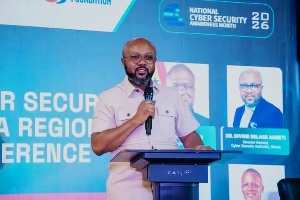
 Director General of the Cyber Security Authority, Dr Divine Selase Agbeti
The Director-General of the Cyber Security Authority (CSA), Dr Divine Selase Agbeti, has announced plans to establish a regional office of the authority in Ho before the end of 2026 to strengthen the fight against cybercrime in the Volta Region.
The office is expected to support law enforcement agencies in tracking cybercrime suspects and responding to cyber-related offences as authorities intensify efforts to prevent criminals from using the region as a hideout.
Speaking at the 5th Cyber Secure Volta Conference 2026, organised by the Genius IT Foundation in collaboration with the CSA, the University of Health and Allied Sciences (UHAS) and the Volta Regional Coordinating Council in Ho, Dr Agbeti said the office would improve the authority’s ability to assist security agencies in identifying and apprehending suspects.
“Before the end of 2026, we are going to have our Cyber Security Authority office here in Ho, and they will support our law enforcement agencies, which means we can find you in real time. All they need to do is to call, give us a number, and we’ll find them for you,” he said.
He disclosed that the CSA had made several arrests and secured prosecutions since 2025, with a significant number of the operations taking place in the Volta Region.
According to him, some cybercriminal networks had relocated from Accra to Ho and other communities because of the region’s peaceful environment.
He, however, stressed that the presence of cybercriminals in the region did not necessarily mean they were natives of the area.
Dr Agbeti said the government remained committed to ensuring that no part of Ghana became a haven for cybercriminals. He added that President John Dramani Mahama had designated a specialist cybersecurity force as part of broader efforts to strengthen the country’s response to cybercrime.
He urged residents to support the fight by reporting suspicious activities in their communities, particularly in houses where large numbers of young people appeared to work through the night using laptops, mobile phones and internet equipment.
He also advised landlords to make reasonable enquiries about prospective tenants before renting out their properties and encouraged residents to report signs of unexplained wealth and other suspicious behaviour.
Residents can report cybercrime incidents to the CSA through the short code 292, which operates 24 hours a day.
Dr Agbeti further called for increased public awareness, describing cybersecurity as a shared responsibility involving individuals, families, businesses and public institutions.
He urged participants to prioritise personal online safety, invest in cybersecurity within their institutions and share knowledge with family members, friends and neighbours, particularly those with limited digital skills.
The call comes amid rising reported cybercrime incidents and financial losses in Ghana.
According to Dr Agbeti, the CSA recorded 4,604 cybersecurity incidents in 2025, resulting in reported financial losses exceeding GH¢22.5 million.
Between January and September 2026, the authority had already recorded 4,938 incidents, with estimated losses of GH¢209.7 million.
He cautioned that the figures represented only incidents reported to the authority, noting that some victims were reluctant to report their experiences because of embarrassment or fear of ridicule.
The conference, organised as part of the National Cyber Security Awareness Month 2026 regional activities, focused on digital financial safety and online security.
Dr Agbeti warned that although mobile money, internet banking and digital wallets had made financial transactions more convenient, they had also created opportunities for fraudsters to exploit unsuspecting users.
The Volta Regional Minister, James Gunu, urged government workers to practise good cyber hygiene in their personal and official online activities, warning that cyber risks to public institutions could undermine public trust and the effective delivery of services.
The Executive Director of the Genius IT Foundation, Desmond Kitsi, said the initiative began in 2022 to make cybersecurity awareness a regular practice rather than an afterthought.
He disclosed that the foundation had sensitised more than 1,600 people in the previous year and was expanding its CyberSecure Programme nationwide through awareness zones, ambassadors and a “Cybersecurity for Life” course targeting all 16 regions.

Copyright © 1994 - 2026 GhanaWeb. All rights reserved.










