



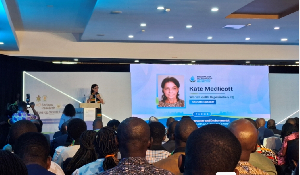
 Participants seen sited at the meeting
The Wastewater and Environmental Surveillance Meeting 2026 has opened in Accra, bringing together global health experts, scientists, and policymakers to strengthen disease prevention through wastewater monitoring.
The meeting, organised by the Kwame Nkrumah University of Science and Technology and the Ghana Health Service, is focused on integrating wastewater surveillance into national and global health systems under the One Health approach.
Dr Fiona Braka, World Health Organisation (WHO) Country Director for Ghana, said at the opening of the event that wastewater surveillance was a critical complement to clinical systems, particularly in low- and middle-income countries.
She explained that analysing sewage and environmental samples provided population‑level insights into infectious agents, antimicrobial resistance and chemical exposures.
“Surveillance is incomplete unless it leads to meaningful action, such as targeted testing, vaccination strategies, or policy adjustment,” she said.
The opening day featured evidence from Uganda, Bangladesh and other regions on how wastewater monitoring had detected cholera, hepatitis E and tuberculosis.
International partners including WHO, the Gates Foundation, Africa Centres for Disease Control and Prevention, US CDC and the Environmental Protection Authority are participating.
Dr David Blazes, Deputy Director of Genomics, Epidemiology and Modelling at the Gates Foundation, described the meeting as one of the most important public health gatherings of the year.
“The third day’s session on costing will be critical in showing that wastewater and environmental surveillance are efficient and sustainable,” he said.
Prof. Ellis Owusu‑Dabo, Chairperson of the Organising Committee, welcomed participants from across Africa, Asia and beyond, noting logistical challenges faced by many attendees.
He said the conference was a call to action to integrate wastewater surveillance into routine systems, drawing lessons from COVID-19 and other epidemics.
“These are not just theoretical contributions, but evidence of lives that can be saved when we listen to what our water is telling us,” he said.
The conference is expected to produce a report to accelerate the integration of wastewater and environmental surveillance into routine health systems, drawing lessons from COVID‑19 and other epidemics.

Copyright © 1994 - 2026 GhanaWeb. All rights reserved.










