



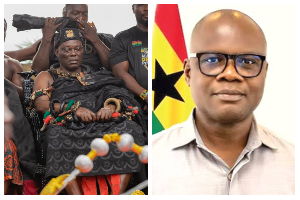
 Central Regional Minister, Ekow Panyin and Denkyira chief
The Central Regional Minister and Chairman of the Central Regional Security Council, Ekow Panyin, has imposed sweeping restrictions on traditional activities within the Denkyira Traditional Area, including the celebration of the revered Akwasidae and the installation of traditional leaders.
The directives, contained in a letter sighted by GhanaWeb, are expected to further heighten tensions between the Regional Security Council and the Denkyira traditional leadership at a time when the traditional area is already grappling with chieftaincy-related disputes.
Among the most significant directives, the Regional Minister has warned the Denkyirahene, Odeefo Boa Amponsem IV, against conducting any traditional ceremony outside the precincts of the palace.
The Minister has also ordered the cancellation of all proposed sub-chieftaincy installations and the installation of any traditional leader by either faction involved in the disputes.
More significantly, the letter directs the suspension of all installation ceremonies until further notice.
“No installation ceremony shall take place until further notice,” the letter states.
The directive effectively places a freeze on a significant aspect of traditional administration within the Denkyira Traditional Area and raises questions about the extent to which the Regional Security Council intends to exercise its authority over traditional affairs.
Akwasidae restriction strikes at the heart of Denkyira tradition
The proposed restriction on Akwasidae is particularly significant.
Akwasidae occupies a deeply revered position in Akan traditional life and is observed as an occasion for traditional authorities and their subjects to honour their ancestors, reaffirm communal bonds, and reaffirm the spiritual continuity between the living and their ancestral heritage.
For the Denkyira people, whose traditional institution carries a history stretching back centuries, any attempt to interrupt such an observance is unlikely to be regarded as an ordinary administrative directive.
The restriction could, therefore, open a new and potentially difficult front between the state security apparatus and the Denkyira Traditional Council.
A kingdom forged in power, politics and war
The historical weight of Denkyira makes the development even more consequential.
Long before the emergence of modern Ghana, Denkyira had established itself as one of the most formidable political and military powers in the southern Gold Coast.
The kingdom's influence was built around gold resources, trade networks, territorial expansion, and considerable military strength. At the height of its power, Denkyira exercised influence over several neighbouring states and held the emerging Asante states within its political orbit.
That dominance eventually culminated in the historic confrontation at Feyiase in 1701, when the Asante coalition, led by Osei Tutu, defeated the forces of Denkyirahene Ntim Gyakari.
The defeat marked a decisive turning point in Akan history, ending Denkyira's dominance and clearing the way for the emergence of Asante as the leading Akan power.
The historical record, therefore, places Denkyira among the great political and military powers that shaped the history of present-day Ghana.
It is this formidable legacy — a kingdom whose history is intertwined with territorial expansion, political contestation, and warfare — that makes the current confrontation particularly sensitive.
The present dispute, of course, belongs to the constitutional and administrative framework of modern Ghana and should not be equated with the warfare of the pre-colonial era. Yet the symbolism and emotional weight of the Denkyira traditional institution remain considerable.
Political undertones deepen the dispute
Adding another layer to the increasingly tense situation are allegations of a political dimension to the Regional Minister's posture towards the Denkyirahene.
It is believed in some circles close to the traditional dispute that the Regional Minister has vowed to frustrate the reign of Denkyirahene Odeefo Boa Amponsem IV, allegedly on account of perceived or suspected links between the traditional ruler's lineage and the New Patriotic Party (NPP).
The allegation, if established, would introduce a distinctly political undertone into what is ostensibly a matter of traditional authority, public order, and the management of chieftaincy disputes.
There is, however, no indication in the directive sighted by this portal that the Regional Minister's actions are politically motivated. The allegation, therefore, remains a matter of contention and would require evidence or a response from the Regional Minister and the relevant authorities.
Nevertheless, the perception among some traditional and political actors that the restrictions may have a political dimension is likely to further complicate an already delicate situation.
The concern is that a dispute that should ordinarily be resolved through the appropriate traditional, legal, and constitutional mechanisms could increasingly become entangled in partisan political considerations.
A collision course
The Regional Minister's latest directives could mark a significant escalation in the continuing contest over authority within the Denkyira Traditional Area.
While the Regional Security Council may argue that the restrictions are necessary to prevent further escalation and maintain public order, the suspension of traditional installations and restrictions affecting one of Denkyira's most important traditional observances could be perceived by sections of the traditional establishment as an unprecedented intrusion into the affairs of the traditional institution.
The development consequently places the Regional Minister and the Denkyira traditional leadership on a potentially combustible collision course.
For the Denkyira Traditional Council, the critical question may now be whether the restrictions constitute a temporary security intervention or an attempt to fundamentally constrain the authority and influence of the Denkyirahene.
That distinction could prove decisive.
If the latter perception takes root, the dispute could rapidly transcend the immediate questions of Akwasidae and chieftaincy installations and develop into a broader confrontation over the constitutional boundaries between state authority, traditional authority, and partisan political interests.
Given Denkyira's extraordinary place in Ghana's political and military history, few would underestimate the significance of such a confrontation.
The battle lines may, therefore, have been drawn — not on the battlefield of Feyiase, but within the constitutional and institutional framework of modern Ghana.
How the Denkyira Traditional Council responds, whether the directives are enforced, challenged, or negotiated, and whether the Regional Minister can de-escalate the growing tension could determine the next chapter of a dispute that is rapidly assuming national significance.
#TrendingGH: 'Revisit the case' - Netizens react to controversial court ruling

Copyright © 1994 - 2026 GhanaWeb. All rights reserved.










