


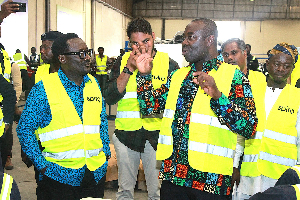
 Minister of Labour Emmanuel Kwadwo Agyekum (R) with Spiro MD, Maxwell Dodd (L)
The Minister of Labour, Jobs and Employment, Emmanuel Kwadwo Agyekum, has challenged electric motorcycle manufacturer Spiro to expand its operations in Ghana and increase local production, saying the country's growing youth population needs more employment opportunities.
He made the call during a visit to Spiro's warehouse, where he commended the company for employing young Ghanaians and equipping them with practical skills to assemble electric motorcycles.
“Creating jobs is not rocket science. It is doable,” Agyekum said, assuring the company of government support to expand its operations and create more employment opportunities.
He said Spiro's operations demonstrated how local manufacturing could help address unemployment, particularly among young people who had completed Junior High School (JHS) and Senior High School (SHS).
However, he urged the company to go beyond assembling imported components and work towards producing more motorcycle parts locally.
According to him, greater local participation in the motorcycle manufacturing value chain would reduce Ghana's dependence on imported components while creating additional opportunities for local businesses and skilled workers.
The call comes amid persistent youth unemployment in Ghana. Data from the Ghana Statistical Service (GSS) show that unemployment among people aged 15 to 35 averaged 21.9 per cent during the first three quarters of 2025, compared with the national average of 12.8 per cent.
The GSS also reported that nearly two million young people were not in employment, education or training by the third quarter of 2025, underscoring the need for sustainable job creation and skills development opportunities.
Meanwhile, Spiro's Managing Director, Maxwell Dodd, disclosed that the company was targeting approximately 2,000 jobs when its operations reached full capacity.
He said the company was preparing for a nationwide deployment of electric motorcycles, alongside an expansion of its battery-swapping network to make the vehicles more accessible to riders.
According to Dodd, the full-scale rollout, expected to begin in January 2027, would involve the production of 300 motorcycles daily, supported by battery-swapping stations operating around the clock.
He explained that the battery-swapping system would allow riders to exchange depleted batteries for fully charged ones instead of waiting for their motorcycles to recharge.
On the financial benefits, Dodd said riders could earn between GH¢400 and GH¢500 daily while reducing their operating expenses by approximately 40 per cent compared with fuel-powered motorcycles.
He added that Spiro was introducing savings and insurance schemes to improve the financial security of riders and their families.
Dodd further said the motorcycles were assembled in Ghana by young people who had received the necessary training to meet the company's quality standards.
He appealed to the government to provide continued support, particularly through tax incentives and policies that would create a favourable environment for the company's expansion into other parts of the country.
Ghana's transition towards electric mobility also presents opportunities beyond the transport sector. The Ministry of Energy and Green Transition has identified local vehicle assembly, battery value-chain development, charging infrastructure and technical skills development as areas with potential for industrial growth and green employment.
However, the extent to which such investments translate into sustainable jobs will depend partly on local sourcing, skills transfer and the development of supporting industries.
With Spiro targeting 2,000 jobs and a daily production capacity of 300 motorcycles, the proposed expansion could provide an opportunity to advance Ghana's electric mobility and local manufacturing ambitions.
EA

Copyright © 1994 - 2026 GhanaWeb. All rights reserved.










