



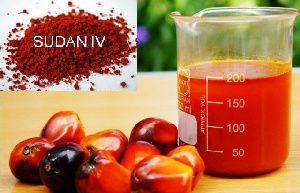
 A collage of Sudan dye, palm oil in a measuring cup and some palm nuts
GhanaWeb Feature by Veronica Penelope Onuman
The recent arrest of women in Ghana’s Eastern Region for allegedly using Sudan dye to enhance the colour of palm oil, as reported by GhanaWeb in the article titled “7 women arrested in possession of palm oil adulterated with ‘Sudan dye’,” on April 17, 2026, has once again brought a longstanding public health concern back into focus.
What may appear as richly coloured, high-quality palm oil could, in reality, be concealing a dangerous public health threat.
Palm oil is a staple in many Ghanaian households, valued not only for its flavour, but also for its nutritional benefits.
Its natural reddish hue, derived from carotenoids, is often seen as a mark of quality. However, this very characteristic has become a target for manipulation.
Beneath the rich, deep red hue that many consumers associate with quality lies a dangerous reality; one that threatens both public health and confidence in a national staple.
This GhanaWeb report explores why Sudan dye is used in palm oil and the serious health threats it poses to unsuspecting consumers.
The appeal of colour and the deception behind it
Palm oil is deeply embedded in Ghanaian cuisine, prized for its natural reddish-orange colour derived from carotenoids.
However, in a market where consumers often equate deeper colour with better quality, some producers resort to artificial enhancements.
GIPC CEO rallies investors to back oil palm expansion at Birim Oil Mills
According to a publication on datelinehealthafrica.org titled ‘Ghana FDA Warns About Adulterated Palm Oil’ on, September 6, 2024, Sudan dyes, particularly Sudan IV, are industrial chemicals used in products such as textiles, plastics, and cosmetics, not food. Yet they are illegally added to palm oil to intensify its colour and increase its market appeal.
This practice is not new. A KNUST research by Jacob Amoako-Mensah in July, 2016, titled “Assessment of the prevalence of Palm Oil adulteration with Sudan IV dye in the Greater Accra Region” and regulatory checks have repeatedly uncovered widespread adulteration in Ghanaian markets, with some surveys detecting Sudan dye in a significant proportion of sampled palm oil.
A toxic ingredient in everyday meals
The danger of Sudan dye lies in its chemistry. Classified as a carcinogenic substance, it is banned globally as a food additive due to its harmful effects on human health.
The danger in the use of this dye in foods was highlighted in an article by ec.europa.eu title ‘Background about Sudan dyes in food Toxicity of Sudan I.’
“Sudan I, II, III and IV are industrial dyes normally used for colouring plastics and other synthetic materials. The current EU legal framework on colours in food establishes a EU positive list of colours authorised for use in food to the exclusion of all others.
“As Sudan dyes are not included in this list, the presence of these dyes in food contravenes EU legislation. Sudan I is fraudulently used to enhance the colour of the food,” the article stated.
A report, “Trend of Sudan Dye Adulteration on Ghanaian Market and Associated Regulatory Interventions: 2018 -2023,” published on fdaghana.gov.gh stated that health authorities also warn that consuming palm oil contaminated with Sudan dye can increase the risk of cancer, particularly with prolonged exposure.
From another article; “Does the Colour Really Matter When Purchasing Palm Oil?” published on fdaghana.gov.gh, the dye has also been linked to damage to vital organs such as the liver and kidneys, as well as allergic reactions and other chronic health conditions.
Because palm oil is used daily in many Ghanaian homes for stews, soups, and frying, the risk is not occasional but cumulative. Even small amounts consumed over time can pose significant health threats.
OSP investigates alleged GH¢25.8 million palm oil scam
A persistent public health challenge
Despite years of public education and regulatory action, the problem persists. The Food and Drugs Authority (FDA) has repeatedly warned about the presence of Sudan dye in palm oil on the market, describing it as a serious health risk.
Testing has shown fluctuating but concerning levels of contamination. The fact was corroborated in a news report “30 percent of palm oils on Ghanaian markets fail FDA’s nationwide zero Sudan dye test,” by businessghana.com on March 17, 2022.
According to this report, in some nationwide checks, about 30% of sampled palm oil failed safety tests for Sudan dye, with certain markets recording even higher rates.
Authorities have carried out arrests and seizures over the years, yet enforcement remains difficult, especially within informal supply chains where monitoring is limited.
Why the practice continues
The continued use of Sudan dye reflects deeper structural issues. Poor processing methods can lead to duller-coloured oil, making artificially enhanced products more competitive.
At the same time, consumer preference for bright red oil creates a demand that unscrupulous producers exploit.
Economic pressures also play a role. For small-scale producers, the temptation to improve the visual appeal of their product and thereby increase sales can outweigh concerns about legality or health risks.
The limits of consumer detection
One of the most troubling aspects of Sudan dye adulteration is that it is difficult to detect without laboratory testing.
Experts note that there is no reliable rapid test available at the market level, leaving consumers largely dependent on trust and regulatory oversight.
While unusually bright or uniform colouring may raise suspicions, such visual cues are not definitive. This makes the issue not just one of individual vigilance, but of systemic food safety enforcement.
Strengthening enforcement and awareness
The recent arrests in the Eastern Region signal renewed efforts by authorities to clamp down on the practice. But experts argue that enforcement alone is not enough.
There is a growing call for: • Stronger market surveillance and routine testing • Harsher penalties for offenders • Improved education for producers on safe processing methods • Greater consumer awareness about the risks of overly bright palm oil
Furthermore, proposals for traceability systems could help ensure that palm oil sold in markets can be tracked back to safe and verified sources.
Protecting a national staple
Palm oil is more than just a cooking ingredient, it is part of Ghana’s cultural and economic fabric.
Ensuring its safety is therefore both a public health priority and a matter of national importance.
The vivid red colour that once symbolised richness and quality must not become a disguise for danger.
As authorities intensify their response following the latest arrests, the challenge remains clear; to protect consumers, restore trust, and ensure that what ends up on Ghanaian tables nourishes rather than harms.
The 4 reasons Justice Dorgu is under fire over judgement in RNAQ divorce case:

Copyright © 1994 - 2026 GhanaWeb. All rights reserved.










