



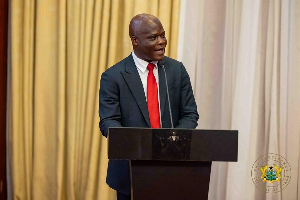
 Minister of Local Government, Chieftaincy and Religious Affairs, Ahmed Ibrahim
The Ministry of Local Government, Chieftaincy and Religious Affairs has established a specialised multi-sectoral committee to create a comprehensive national database of shrines and religious sites across Ghana.
Sector Minister Ahmed Ibrahim made the announcement during an appearance before Parliament's Committee on Assurances, explaining that the working group would bring together officers from the Chieftaincy and Religious Affairs Directorate, the Policy, Planning, Monitoring and Evaluation Unit, and the Research, Statistics and Information Management Unit, with support from Regional Coordinating Councils across the country.
The minister stressed that before any counting could begin, the government first needed to settle on a clear and legally sound definition of what constitutes a shrine.
"A shrine can be a pen. It can be a picture. It can be anything. And these are spiritual issues. The lawyers may disagree with you. So we need to have a very firm foundation," he said.
Ibrahim pointed to the unique challenges of mapping shrines compared to conventional religious buildings, noting that their spiritual and often invisible nature made identification particularly difficult.
"This is simply because a shrine is not just a place. It could be anything. If I want to count shrines, I need to be given the power to be able to remove your shirt and do a body check," he said.
The minister also broadened the conversation to cover the government's overall interest in documenting all forms of religious practice in the country, including mosques, churches and traditional African religious sites.
"Don't you think that you need to know the records of mosques, churches and the traditional African religious places we have in this country?" he said.
He acknowledged that the question of the definition remained open, raising the possibility that a shrine could be anything and not just a physical structure.
"As to what a shrine is, we have to decide if a shrine is a house or someone's pocket or someone's singlet," he said.

Copyright © 1994 - 2026 GhanaWeb. All rights reserved.










