



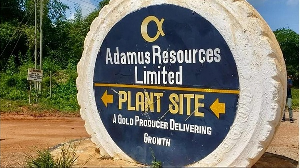
 The committee's findings reveal discrepancies in gold production and shipment records
The Ministerial Review Committee has uncovered significant financial and reporting discrepancies in the operations of Adamus Resources Limited, raising questions about the revenue Ghana may have lost from the company’s mining activities.
The committee’s findings reveal discrepancies in gold production and shipment records, outstanding statutory obligations and debts owed to state institutions, suggesting that the financial implications of the Adamus case may be greater than previously reported.
According to the committee’s findings on the revocation of Adamus Resources’ mining leases, the company was in arrears of GH¢86.78 million in royalties payable to the Minerals Income Investment Fund (MIIF) dating from 2020.
The company also had GH¢119.04 million in tax arrears owed to the Ghana Revenue Authority (GRA) dating from 2023, as well as US$2.56 million in annual payments owed to the Minerals Commission.
The figures put the company’s total statutory arrears at approximately GH¢205.83 million, in addition to the US$2.56 million owed to the Minerals Commission.
These represent funds that, according to the committee, should have been paid to the state as part of the company’s obligations for extracting Ghana’s mineral resources.
US$224m transferred to related parties
The financial concerns become more significant when the company’s unpaid obligations are considered alongside transfers to related parties.
The committee’s review of Adamus Resources’ financial statements found that the company transferred more than US$224.61 million to related parties between 2020 and 2024.
Of this amount, approximately US$123.14 million was transferred to Segala Mining Corporation SA, Semico 1 and Semico 2 in Mali.
The committee therefore rejected the explanation that the failure to meet statutory obligations was simply due to a lack of cash or temporary financial difficulties.
Its findings suggested that while significant statutory obligations remained outstanding, substantial amounts were being transferred to related companies.
The committee said the situation raised questions about the company’s compliance with its financial obligations to the Ghanaian state.
For a country whose mineral resources are held in trust for its people, the findings raise broader public-interest concerns.
A mining company is required to accurately declare its production and pay royalties, taxes and other statutory charges. Failure to meet those obligations could deprive the state of revenue needed to support public services, infrastructure and national development.
The committee also identified outstanding debts owed by Adamus Resources to institutions including GOIL and GRIDCo. Further details of those debts are expected to be released.
Questions over gold production figures
The committee also uncovered inconsistencies in the company’s gold production and export records.
According to the findings, Adamus Resources failed to produce its statutory Gold Production Book, forcing the committee to rely on Form 16A monthly returns and royalty returns submitted to the GRA.
Those records also contained discrepancies.
Between 2020 and January–March 2026, differences between Form 16A records and GRA royalty returns amounted to 6,580.04 ounces of gold, with the committee estimating the associated revenue variance at approximately US$27.13 million, using the Bank of Ghana exchange rate of July 12, 2026.
The committee also identified differences among figures submitted by Adamus Resources and various state institutions.
For the period covering 2024 to January–March 2026, the records showed:
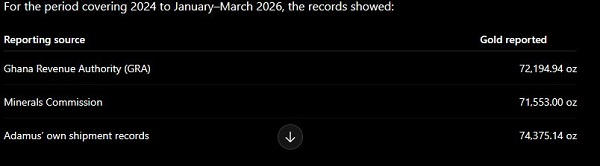
The discrepancies have raised questions about whether the actual volume of gold produced and exported was properly reported.
The committee identified additional variances, including amounts estimated at approximately US$12.02 million and US$21.30 million.
These differences are significant because the volume of gold produced and exported directly affects the royalties and taxes payable to the state.
The committee subsequently described some of the records as “suspicious” and concluded that they had been prepared with the purpose of evading statutory liabilities.
If established through the appropriate enforcement and legal processes, such conduct would raise serious concerns about Ghana’s ability to accurately account for its mineral production and revenue.
Traditional Council raises concerns
The financial concerns also extend to the Eastern Nzema Traditional Area, which raised concerns over an alleged US$2.5 million outstanding balance from a US$10 million Community Development Fund.
The Traditional Council also alleged that mineral royalties due to it had not been paid for eight years.
The concerns were accompanied by complaints about inadequate infrastructure, deteriorating roads, flooding and challenges associated with the Salman Resettlement Project.
Adamus recorded over US$1bn in gold
Records from the GRA indicate that between 2020 and January–March 2026, Adamus Resources recorded approximately 8.8 tonnes of gold, valued at more than US$1 billion.
Under the applicable arrangements, 10% of the relevant proceeds was expected to be paid to MIIF.
However, the records indicate that the company defaulted on its obligations to MIIF while also having outstanding tax obligations to the GRA.
The findings therefore raise questions about the extent of revenue that may have been lost to the state during the period.
Questions over EPA permits
The review also identified concerns about the timing of Environmental Protection Agency (EPA) permits issued to Adamus Resources for its operations in the Ellembelle District of the Western Region.
One permit, EPA/EMP/313, covers operations at Salman and states that the authorisation was valid from July 20, 2017, to July 19, 2020.
However, the certificate was officially issued on December 19, 2024, more than four years after the stated validity period had expired.
A second permit, EPA/EMP/316, covers the Nzema Gold Mining and Processing Operation and states that the authorisation ran from December 21, 2023, to December 20, 2026.
The certificate, however, was issued on December 16, 2024.
The timing has raised questions about how the company operated during periods when the relevant permits had either expired or had not yet been formally issued.
The circumstances surrounding the issuance and renewal of the permits, as well as the company’s operations during the periods in question, require further clarification from the relevant regulatory authorities.
Review of lease revocation
The Ministerial Review Committee was established by the Minister for Lands and Natural Resources, Emmanuel Armah-Kofi Buah, after Adamus Resources petitioned against the revocation of its Nkroful, Akango and Salman mining leases.
The committee’s findings point to significant financial, regulatory and reporting issues that it said require further scrutiny.
It recommended that the revocation be upheld and called for additional regulatory, environmental and financial enforcement measures, including a comprehensive audit of the company’s activities.
The findings have raised broader questions about accountability in Ghana’s mining sector, particularly regarding the accurate reporting of gold production, payment of statutory obligations and the enforcement of environmental and mining regulations.

Copyright © 1994 - 2026 GhanaWeb. All rights reserved.










