



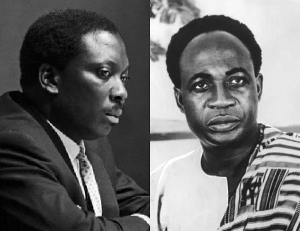
 Alex Quaison-Sackey (L) was Dr Nkrumah's (R) Foreign Minister
Just days after Dr Kwame Nkrumah was overthrown in the February 24, 1966 coup, his Foreign Minister, Alex Quaison-Sackey, returned to Ghana and publicly expressed support for the new National Liberation Council (NLC) government.
Quaison-Sackey, who was in China with Nkrumah when the coup took place, declared upon his return to Accra on March 2, 1966, that there was “a fresh whiff of air blowing through Ghana.”
THROWBACK: Massive crowds welcome Nkrumah during historic Nigeria visit in 1959
“I made up my mind that I would come back home to submit myself to the new government, that since I had been dismissed and since all ministers had been detained, and since I was a minister, I had to come back and make my position known to the new government. If I may say so, once I arrived in Accra, there was a fresh whiff of air blowing in Ghana,” he said in an old interview.
He also spoke about growing discontent among Ghanaians, citing the high cost of living, shortages of food and other goods, and dissatisfaction with the performance of some government ministries.
“There was no doubt that there had been pent-up feeling among the population for a number of years,” he said.
However, his memoir, The Memoirs of Alexander Quaison-Sackey, offers a different account of his actions immediately after the coup and suggests that Nkrumah had entrusted him with a mission to defend his government.
According to the memoir, a copy of which was sighted by GhanaWeb, Nkrumah summoned Quaison-Sackey to his bedroom in Peking, now Beijing, on the morning of February 26, 1966, as the former President prepared to leave for Addis Ababa, Ethiopia.
Quaison-Sackey recalled that Nkrumah was visibly emotional and asked him to kneel before him before praying for him and sending him on the mission.
“On the morning of my departure from Peking, that was, Saturday, February 26, 1966, I was summoned at dawn to Osagyefo’s bedroom. He was still lying in bed, his eyes very red, holding a white handkerchief,” Quaison-Sackey wrote.
“He made me kneel before him and he placed his right palm on my head and said, ‘My spirit go with you’,” he continued.
Quaison-Sackey said he was travelling to Addis Ababa to defend what he described as the constitutional and legal government headed by Nkrumah, while the NLC had also dispatched a delegation from Accra to Ethiopia.
“Thus, on Saturday, February 26, 1966, I set out on a very important mission on behalf of Osagyefo Dr Kwame Nkrumah, to Addis Ababa in Ethiopia to fight for the ‘constitutional and legal government of which Dr Kwame Nkrumah is the head’ against the National Liberation Council,” he wrote.
The former Foreign Minister said he travelled with Dr J. E. Bossman, then Ghana’s High Commissioner in London; J. H. Sackey, Director of the Eastern European and China Desk; and his personal assistant, Albert K. Haynes.
See rare photo of Kwame Nkrumah and Fathia's wedding
In his account, Quaison-Sackey also stated that he and his companions believed they were under surveillance during their stay in China.
His memoir’s account of the mission appears to contrast with his public comments after returning to Ghana, when he expressed support for the NLC and described the atmosphere in the country as one in which there was “a fresh whiff of air blowing through Ghana.”
Just six days after Nkrumah’s overthrow, his Foreign Minister Alex Quaison-Sackey, who was with him abroad when the coup struck, returned to Ghana, backed the new regime and declared there was “a fresh whiff of air blowing through Ghana” — Accra, 2 March 1966. pic.twitter.com/Sq884NIHnX
— GHANA FACTS & HISTORY (@GhanaianMuseum) August 19, 2026
Find and buy the book the next time you are at the bookshop! Pages 277- 290 specifically addresses this. AQS recounts how things as stated in page 283 eventually resulted in him making a beeline for Accra instead. https://t.co/GTYJ2xxzcs pic.twitter.com/NMSU0sNyb2
— Perfume and Prose (@bookpresse) August 20, 2026

Copyright © 1994 - 2026 GhanaWeb. All rights reserved.










