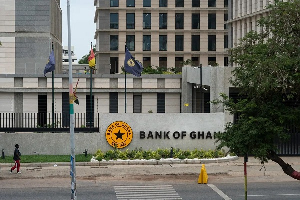
 Bank of Ghana's heaadquarters
Pressure is mounting on both the Bank of Ghana and the Ghana Gold Board to meet the ambitious targets set under the Ghana Accelerated National Reserve Accumulation Programme (GANRAP) which aims to raise reserves to 15 months of import cover by the end of 2028, with minimum interim milestones of 8.6 months by end-2026 and more than 11.8 months by end-2027.
This because a combination of the fall in gold prices of about 20% over the past nine months, increased demand for foreign exchange on the domestic forex market, the rise in yields on United States treasuries – brought about by falling bond prices – and impending large debt repayment obligations in foreign currencies, have thrown the original projections underpinning GANRAP askew and significantly complicate the computations for accumulating gross reserves.
Consequently, the central bank, Goldbod and the Ministry of Finance itself are now being forced to recalibrate their projections, plans and actual actions in coordination with each other in a bid to meet the GANRAP targets – or more likely simply get as close to them as possible.
The reserve gap is widening in relation to the policy ambition
The BoG’s September economic and financial data showed gross reserves of US$12.05 billion as at September 22, equivalent to 4.5 months of import cover.
These figures are materially below the policy’s end-2026 target of 8.6 months. Moving from 5.7 months at end-2025 to 8.6 months at end-2026 means gaining 2.9 months of import cover in a single year. The subsequent rise to 15 months by end-2028 requires a further 6.4 months over two years.
The policy estimates that the overall three-year objective requires an average net addition of US$9.5 billion annually after meeting external debt service, energy-sector payments, foreign-exchange operations and other outflows.
Ghana is not meeting this target despite its best efforts. To be sure GoldBod’s September performance was substantial. The Board reported generating US$1.871 billion in foreign exchange from Artisanal Small Scale Mining (ASM) gold trading, exceeding its US$1.4 billion target by US$471 million.
Of the September proceeds, US$701.3 million was sold to authorised commercial banks, while US$1.170 billion was provided to BoG to support reserve accumulation. In August, GoldBod had supplied the central bank with US$646.59 million for reserves, after generating US$1.315 billion in foreign exchange overall.
The September allocation was therefore a notable acceleration in the direct transfer of GoldBod-generated foreign exchange to the central bank.
But the October plan indicates a more cautious balance. GoldBod announced a US$1.5 billion foreign-exchange generation target, with US$1 billion intended for commercial banks to support market stability and up to US$500 million earmarked for BoG reserve accumulation.
GoldBod accumulated and sold approximately US$452 million directly to authorized commercial banks using its GoFX digital platform during the first three weeks of October, but data was not immediately available on how much it transferred to the BoG
for reserve allocation, and how much of its entire month forex receipts target had been met.
But the need to accumulate reserves and the need to meet the forex needs of the local economy create a fundamental friction. Dollars supplied to commercial banks can ease shortages faced by importers and reduce pressure on the cedi while dollars retained by the central bank add to reserve buffers. In a period of heightened foreign-exchange demand, the institutions cannot maximise both outcomes simultaneously from a fixed pool of export receipts.
The coordination challenge is to establish transparent rules for deciding how much foreign exchange should be accumulated, how much should be released into the domestic market and how much should be held in cash for foreseeable public-sector payments.
Gold’s price and the Treasury-market problem
To be sure the assumptions underpinning GANRAP have become less favourable.
The policy’s benchmark of US$5,000 an ounce implies annual gross receipts of approximately US$25.3 billion from its 3.02-tonne weekly purchase target.
Yet gold finished September at US$4,176 an ounce, down 8.5 per cent during that month alone. Its analysis attributed much of the decline to rising US Treasury yields and a stronger dollar. The US 10-year Treasury yield climbed 53 basis points to 5.3 per cent over September.
At US$4,176 an ounce, the same annual gold volume would generate roughly US$21.1 billion before costs, approximately US$4.2 billion less than the policy’s US$5,000 price assumption. The price weakness is especially consequential because gold is a non-yielding asset. Higher Treasury yields make dollar-denominated securities more attractive to investors, while falling bond prices increase the yields available on newly purchased securities.
For Ghana, this creates a two-sided reserve-management decision. Gold offers diversification, protection against some financial and geopolitical shocks, and the potential for long-term capital appreciation. Cash and short-term dollar securities offer liquidity and interest income, making them more useful for near-term debt service and foreign-exchange intervention.
The central bank therefore has to avoid treating the market value of its gold holdings as equivalent to immediately spendable dollars. A decline in bullion prices can reduce the reported value of reserves even where the physical quantity of gold has increased.
BoG Governor Dr Johnson Pandit Asiama acknowledged the exposure when discussing the August slowdown in gold shipments. He said the principal risk was international gold prices, which Ghana could not control, and that favourable prices were important to sustaining the contribution of shipments to reserves.
The BoG’s forex market intervention responsibilities
Further complicating the BoG’s decision making process with regards to the accumulation off gross international reserves are its own responsibilities with regards to intervening in the local forex market. To the irritation of the International Monetary Fund but the applause of local economists, the BoG sometimes intervenes in the domestic forex market outside of its usual intermediation activities.
Dr Asiama insists that such interventions are triggered, rather than are arbitrary and BoG forex market officials further explain that they are triggered through a complex economic model that considers many factors at the same time including the rate of change of the exchange rate in both absolute and percentage terms, the underlying imbalance between demand for and supply of forex and the impact of forex rate changes on domestic inflation. This economic model is run every day to identify when central bank intervention is needed. Consequently, the central bank often sees the need to take part of the reserves already accumulated and put it up on the market.
Debt payments will compete with accumulation too
The other constraint is Ghana’s external debt-service burden.
The IMF’s 2026 projections put total external debt service at approximately US$4.7 billion for 2026, US$5.05 billion for 2027 and US$5.3 billion for 2028. These amounts include principal and interest across external public debt obligations.
Ghana also faces scheduled repayments to the IMF. The Fund’s September 30, 2026 payment schedule lists approximately SDR103 million due during the remainder of 2026, SDR244 million in 2027 and SDR262 million in 2028. These are projected payments and include charges as well as principal repayments.
Domestic debt creates an additional fiscal pressure. The IMF has warned that the maturity of restructured domestic bonds will produce significant rollover needs in 2027–28. Ghana has had to establish dedicated sinking funds, funded through earmarked non-oil tax revenues and Treasury bond issuance, to help meet these redemptions.
The implications for GANRAP are clear. Reserve accumulation cannot be planned in isolation from the debt-management strategy. Government must forecast the foreign-exchange payments falling due each quarter, distinguish those that can be met from export proceeds from those requiring reserves, and avoid building an ambitious headline buffer while creating avoidable liquidity pressure elsewhere.
What must change if the targets are to be met?
The most urgent requirement is to publish and implement a coordinated reserve-management plan that links GoldBod’s monthly purchasing and FX-generation targets to BoG’s reserve composition and the Finance Ministry’s debt-service calendar.
First, Ghana needs to maximise the quantity of gold acquired and exported without allowing purchase costs, financing arrangements or trading spreads to erode the proceeds. The IMF’s assessment that programme costs should fall towards 5 per cent is central to this effort.
Second, the authorities need to diversify the sources of reserve accumulation. GANRAP itself identifies non-traditional exports, higher cocoa productivity, remittances, new oil production, reduced foreign-exchange leakages in the energy sector and fiscal discipline as complementary measures.
Third, BoG should maintain a clear liquidity hierarchy: cash and short-duration dollar assets for near-term obligations; gold for strategic diversification; and longer-duration securities only to the extent that their price and liquidity risks are consistent with reserve adequacy.
Finally, the government should assess the reserve milestones against actual import growth, gold prices and external payment obligations rather than relying on a fixed valuation assumption.
The outlook is challenging. GoldBod’s September receipts demonstrate that the operational machinery can generate substantial foreign exchange, and the institutional transfer to GoldBod provides a clearer division of responsibility.
But the gap between the reported reserve position and the ambitious import-cover milestones, alongside weaker gold prices and large debt-service commitments, means the 2026 target is at serious risk unless accumulation accelerates sharply, even though the longer-term 15-month objective may remain attainable if gold production and exports expand, programme costs fall, non-gold inflows strengthen and fiscal policy prevents reserves from being repeatedly drawn down.

Copyright © 1994 - 2026 GhanaWeb. All rights reserved.