



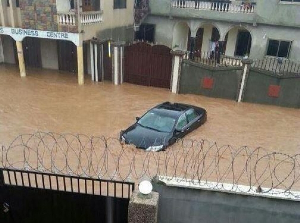
 Natural flood retention areas for excess rainwater have largely been built over
The Ghana Meteorological Agency (GMet) has warned that parts of Accra may experience flooding with as little as, 30 millimetres of rainfall, as it predicts about 100 to 150 millimetres of rain in the month of June.
According to GMet's June 2026 Rainfall Outlook, the Coastal Zone, including Accra, is expected to record predominantly normal to above-normal rainfall, raising concerns about flooding in vulnerable communities.
Speaking on the growing flood risk, GMet's Deputy Director and Head of Research and Applied Meteorology, Francisca Martey, said Accra's ability to absorb and drain rainwater had deteriorated significantly due to rapid urbanisation and unchecked development.
In a report by graphic.com.gh on June 10, 2026, she explained that flooding in the capital is no longer determined solely by rainfall recorded within the city.
"When it rains in Accra, Accra rains do not collect only in Accra. It counts Berekusu and other surrounding areas. All of them come to Accra," she said.
Martey noted that natural flood retention areas that once served as reservoirs for excess rainwater have largely been built over, leaving stormwater with limited pathways.
"All those places are naturally made to collect rainwater. Now all those places have been built into. So, what are we expecting?" she questioned.
According to her, the city's drainage infrastructure is increasingly overwhelmed because urban development has concentrated runoff into narrow gutters that cannot handle large volumes of water during heavy rainfall events.
Stakeholders meet over urban planning after Accra hit by floods, transportation crisis
"At first, the rain would spread over a broad area and gradually seep into the ground. Now we have brought all of it into narrow gutters. Once the volume exceeds their capacity, the water spills out and floods surrounding areas," she explained.
She cited the Bel Aqua area in Tema as an example of development taking place on natural watercourses, worsening flooding challenges.
"When you get to Bel Aqua in Tema, you realise the area sits on a watercourse. The last time I travelled through there, it took me more than two hours to get from the overhead bridge to the junction after work. Bel Aqua is built on a watercourse, which contributes significantly to the flooding challenges in the area," she said.
Martey stressed that while GMet's responsibility is to provide weather forecasts and early warnings, the implementation of long-term flood mitigation measures lies with city planners and relevant authorities.
"The city authorities know exactly what to do. The town and country planning authorities know exactly what to do. I give the forecast. They know what to do," she indicated.
The warning comes as GMet forecasts wetter-than-normal conditions across much of Ghana this month.
In the Forest Zone, areas including Kumasi, Dunkwa and Akim Oda are expected to record between 200 and 400 millimetres of rainfall, while parts of the Transition Zone could receive between 200 and 250 millimetres.
Martey urged disaster management agencies to intensify preparedness efforts, warning that localised flooding remains a major threat despite the expected benefits of increased rainfall for agriculture and water resources.
She called on authorities and community leaders to remain vigilant and implement measures aimed at reducing flood-related risks during the peak of the rainy season.
MRA/VPO
Meanwhile, watch as Joffery Nortey shares his career journey from comedy to content creation

Copyright © 1994 - 2026 GhanaWeb. All rights reserved.










